Economic and industry news or trends
60+ construction statistics, benchmarks and trends for 2026: The ultimate industry data hub
The construction industry is entering the second half of 2026 with no shortage of pressure points: affordability challenges, persistent labor shortages, cautious buyers, rising expectations and tighter profit margins.
For builders, remodelers and contractors, gut instinct isn’t enough anymore. Staying competitive requires knowing where the market is headed – and how your business stacks up.
That’s why we’ve compiled 60+ construction industry statistics, benchmarks and trends from Buildertrend data, the State of Residential Construction Industry Report, NAHB, the U.S. Census Bureau and other trusted industry sources.
Use this data hub to evaluate market conditions, compare your sales and operations against industry benchmarks and uncover opportunities to improve profitability in 2026.
*All sources are cited at the bottom of this blog.
Get the data and insights on how top builders win in 2026 – and beyond.
Construction market and economic statistics for 2026
The statistics below highlight the key economic forces influencing demand, supply and business performance across the industry.
Housing market statistics
- The U.S. housing market is currently short roughly 1.2 million homes, creating significant pressure on builders to increase supply and close the gap between demand and available housing.
- Housing starts are running at a seasonally adjusted annual rate of approximately 1.46 million units.
- NAHB forecasts slim single-family construction growth in 2026, increasing by 1% to 940,000 units.
- Florida and Tennessee tied among the nation’s most popular move-in states.
- The Sun Belt region of the U.S. accounted for 80% of the most popular move-in cities in 2026.
Builder sentiment and market demand statistics
- 67% of builders reported demand was slower than expected in May 2026.
- Some builders described 2026 as the slowest spring market in years.
- Affordability pressures continue to suppress demand despite persistent housing shortages.
Construction labor statistics
- The construction industry needs approximately 740,000 new workers every year to meet current demand and replace departing workers.
- Labor shortages are costing the industry more than $10.8 billion annually through lost productivity and delayed projects.
- Workforce constraints are adding nearlytwo months to construction timelines on average.
- Nearly 41% of the construction workforce is expected to retire by 2031.
Material cost and inflation statistics
- Residential building material prices have experienced annual growth above 3% since June 2025 despite softer housing demand.
- Builders continue to cite material costs as a major pressure on profitability.
- Labor and material inflation remain key contributors to budget overruns.
Construction AI trends
- 66.7% of builders now use AI in their businesses.
- ChatGPT accounts for 91.3% of AI chat tool usage among builders.
What these construction market statistics mean
The 2026 construction market presents a unique mix of challenges and opportunities. Demand for housing remains fundamentally strong, but affordability pressures, labor shortages and rising costs continue to limit growth.
At the same time, builders are increasingly embracing technology to improve efficiency and adapt to changing market conditions. Companies that can control costs, improve productivity and deliver a strong customer experience will be best positioned to navigate the year ahead.
Construction sales and client behavior statistics
Winning projects in 2026 requires more than strong craftsmanship. Builders are navigating changing buyer expectations, affordability concerns and increasingly competitive sales environments.
The following statistics reveal how homeowners are making purchasing decisions, where builders are finding new business and which sales practices are driving stronger results.
Homebuyer demographics and housing preferences
First-time homebuyer age breakdown
- 35% of homebuyers are Gen Z or younger.
- 22% are Millennials.
- 19% are Gen X.
- 20% are Baby Boomers.
- 5% are part of the Silent or Greatest Generation.
Affordability and homeownership
- Approximately 50% of millennials are homeowners looking for a move-up home.
- The remaining 50% of millennials continue renting while evaluating affordability and ownership costs.
- Affordability challenges continue delaying homeownership decisions for younger buyers.
Construction lead generation statistics
- 53% of builders rely on referrals or word-of-mouth marketing to generate new business.
- 35.3% of builders identify generating quality leads as their biggest sales challenge.
- Builders need approximately 21-25 leads to close one contract.
- Roughly 30% of incoming leads become sales-qualified opportunities.
Construction sales process statistics
- 40.8% of builders do not have a documented sales process.
- Builders who use sales scripts report a 50% higher share of qualified leads.
- Companies that conduct regular sales training achieve a 2.5% higher gross markup.
- Builders who charge for quotes report 3-4% higher gross markups than those who provide free estimates.
- 58% of builders close projects within one to three months.
Client expectations and payment preferences
- Marketing and client communications are the top AI use cases among builders.
- 50% of clients pay for projects without financing, loans or credit.
- 95.6% of clients pay using bank transfers.
What these sales and customer behavior statistics mean
The builders winning the most work in 2026 aren’t necessarily generating more leads – they’re converting more of the leads they already have.
The data shows that structured sales processes, consistent training and strong communication practices can have a measurable impact on lead quality, close rates and profitability. At the same time, affordability concerns continue to shape homeowner decision-making, making trust, transparency and a differentiated customer experience more important than ever.
Construction technology and operations statistics
Once a project is sold, operational efficiency becomes one of the biggest drivers of client satisfaction and profitability. Builders are managing multiple jobs at once, coordinating subcontractors, tracking progress and communicating with clients – often while trying to reduce delays and protect margins.
The following statistics show how builders are using technology, processes and project management tools to keep work moving.
Project volume statistics
- 55% of builders complete between 6 and 30 projects annually.
Scheduling and project delivery statistics
- 21.4% of builders still deliver projects late.
- 27.7% of new home builders cite subcontractor delays as their biggest project management challenge.
Construction communication statistics
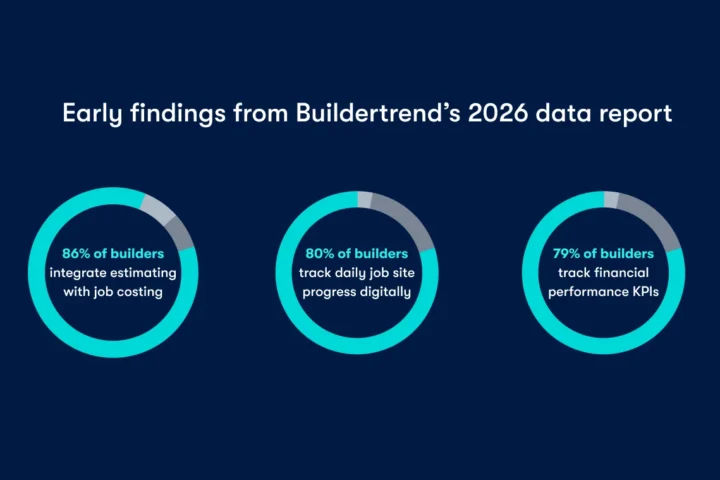
- 80% of builders track daily job site progress digitally.
- 67% of builders provide clients with real-time visibility into project progress.
- 67% of builders have a defined project closeout process or checklist.
Construction software statistics
- 35.9% of U.S. builders use Buildertrend as their project management software.
- 22.1% of builders still use spreadsheets for estimating.
- 31.5% of builders do not use dedicated takeoff software.
Process improvement statistics
- 43.6% of builders do not conduct post-project completion audits.
What these technology and operations statistics mean
Operational maturity is becoming a major competitive advantage in construction. Builders that digitize project tracking, standardize communication and review performance after each job are better equipped to manage complexity and deliver a stronger client experience.
As project volume grows, relying on manual processes or disconnected systems can make it harder to stay on schedule, control costs and scale sustainably.
Construction profitability and financial management statistics
Revenue growth doesn’t always translate into profitability. As labor costs, material prices and project complexity continue to rise, builders are placing greater emphasis on financial visibility, job costing and performance tracking.
The following statistics reveal how builders are managing their finances, monitoring profitability and identifying opportunities to improve margins in 2026.
Revenue statistics
- 67% of builders expect annual revenue between $1 million and $10 million.
Job costing statistics
- 86% of builders integrate estimating directly into job costing.
- 91% of builders track job costs in real time on at least some projects.
- 33% of builders identify labor costs as the biggest challenge to staying on budget.
- 28.6% of builders report going over budget on projects.
Gross margin statistics
- Builders and remodelers are targeting 29-30% gross markup in 2026.
- Only 5% of builders report margins that consistently match targets within 1%.
- 68.1% of builders monitor project gross margins monthly.
- 20% of builders do not fully understand the difference between margin and markup.
Business intelligence and reporting statistics
- 66% of builders actively use dashboards or reporting tools.
- 79% of builders track financial performance or profitability KPIs.
- 81.3% of builders generating more than $10 million annually produce monthly financial reports.
- Only 46.3% of builders generating less than $1 million annually produce monthly financial reports.
Profitability statistics
- Nearly 25% of builders failed to generate a net profit in 2025.
- Builders generating more than $6 million annually reported an average loss of $100,000 among unprofitable firms.
Work in Progress statistics
- 40% of builders do not know how to calculate their WIPAA figure.
Construction accounting statistics
- 82.9% of U.S. builders use QuickBooks as their accounting software.
What these profitability and financial management statistics mean
The data makes one thing clear: financial visibility is becoming a competitive advantage. Builders that consistently track job costs, monitor margins, review financial reports and understand key accounting concepts are better positioned to protect profitability in an increasingly complex market.
As cost pressures persist and margins remain tight, strong financial management may be one of the most important differentiators between builders that grow sustainably and those that struggle to keep pace.
What the data tells us about the future of construction
If there’s one theme that emerges from the data, it’s that today’s builders are operating in an increasingly complex environment.
Housing demand remains strong, but affordability challenges continue to slow buying decisions. Labor shortages are making it harder to keep projects on schedule. Rising costs are putting pressure on margins. And homeowners expect more transparency, communication and professionalism than ever before.
At the same time, the data reveals significant opportunities for builders willing to adapt. Companies are embracing technology, adopting AI, digitizing operations and investing in stronger financial controls. The builders that can combine operational efficiency with financial discipline and an exceptional customer experience will be best positioned to thrive in 2026 and beyond.
The most successful builders benchmark their performance, identify gaps and make data-driven decisions. Whether you’re evaluating your sales process, project management practices, profitability or growth strategy, understanding how your business compares to industry peers is the first step toward improvement.
Get the full picture
The statistics in this article provide a snapshot of the trends shaping residential construction, but they only scratch the surface.
Want deeper analysis and Buildertrend-exclusive benchmark data? Download the full 2026 customer data report to explore detailed insights on sales performance, project management, financial health, technology adoption and the strategies top-performing builders are using to stay ahead.
Sources:
https://buildertrend.com/ebooks/modern-builder-playbook-2026/?tab-page=1
https://buildertrend.com/ebooks/apb-report-2026/
https://www.census.gov/construction/nrc/current/index.html
https://hbi.org/wp-content/uploads/2024/06/Spring-2024-CLMR-HBI-NAHB-FINAL.pdf
https://www.builderonline.com/data-analysis/may-builder-sentiment-stuck-in-a-slow-lane

Based on what you just read, we think you'd enjoy...
These suggestions are made by our team to help you find builders and stories that you relate to!
Back to all blogs