Economic and industry news or trends
The new benchmark for builder efficiency: Early findings from Buildertrend’s 2026 data report
The latest construction industry trends reveal a clear reality that home building has never been more complex.
Residential construction is operating under constant pressure. Demand remains high. But the conditions required to meet that demand have changed. Builders are no longer just managing projects – they are navigating structural challenges that impact every phase of the business.
The pressure is coming from every direction according to Buildertrend’s “The modern builder playbook 2026″ report. Builders are reporting unprecedented pressure across labor, timelines and profitability.
- A housing shortage of roughly 1.5 million homes
- A need for ~723,000 new workers annually
- More than $10.8 billion lost each year to labor-related inefficiencies
- An aging workforce, with 41% expected to retire by 2031
- Project timelines extended by nearly two months on average
This is not a short-term problem. It’s a new operating environment. And within that environment, construction industry trends point to a growing divide.
Some builders are adapting – gaining control and protecting margins. Others are falling behind due to disconnected systems, unpredictable costs and operational issues.
The difference is no longer effort. It’s how the business is run.
What construction industry trends reveal about modern builders
To understand what separates top performers, Buildertrend surveyed hundreds of residential construction professionals managing businesses from $1M to $50M+ in annual revenue. These insights are published in our first-ever customer survey report “The modern builder playbook 2026″ report.
Top-performing builders aren’t just building better homes. They’re running more efficient, data-driven businesses. They’re replacing instinct with measurable insights, fragmentation with connected systems and reactive decisions with structured operations.
Construction is becoming more like a business you can measure, and it’s easier to see how efficient builders really are.
Four shifts defining construction industry trends in 2026
Across the data, four consistent patterns emerge. These construction industry trends define how leading builders are operating today.
1. Builders are becoming business operators
Builders are tracking job costs, financial performance, schedules and construction KPIs with precision. They are managing pipelines, forecasting revenue and operating like CEOs.
2. The operating system of construction is changing
Disconnected workflows are being replaced by centralized platforms. These systems create visibility across job sites, financials and communication. Becoming one of the most important shifts in modern construction management.
3. Profit control is the new competitive edge
Margins are under pressure due to labor costs, material volatility and change orders. Builders who integrate estimating with job costing and track budgets in real time are gaining a clear advantage.
4. Trust still drives growth
Even as technology evolves, relationships remain critical. Referrals and word-of-mouth still drive most new business. Systems are now also playing a key role in strengthening communication and transparency.
The new benchmark for builder efficiency
These construction industry trends point to a clear benchmark:
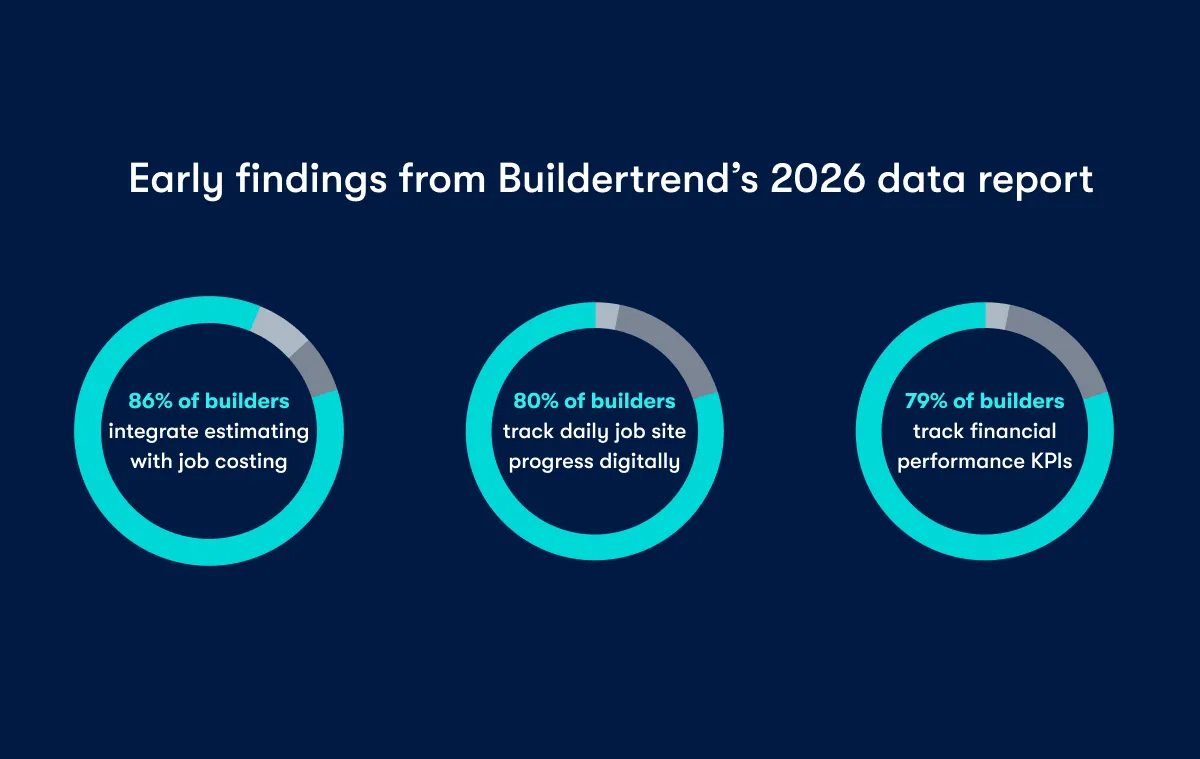
- 86% integrate estimating with job costing
- 80% track daily job site progress digitally
- 79% track financial KPIs
These are no longer advanced strategies. They are becoming the baseline for competitive builders.
What top builders are doing differently
Construction industry trends show that high-performing builders are operating differently:
- Plan like CEOs: Forecast growth, manage capacity, think beyond the next job
- Win the process, not just the price: Structured workflows and clear communication drive decisions
- Run connected job sites: Integrated systems enable real-time visibility and collaboration
- Use financials to drive growth: Track performance, control costs and protect margins
The hidden risk of falling behind
Construction industry trends are exposing the risks for those who don’t adapt.
Builders who ignore these shifts risk:
- Margin compression: Rising costs without the visibility to control them
- Missed growth opportunities: Limited capacity to scale or take on more work
- Increased operational strain: More time spent managing chaos instead of running the business
In today’s market, outdated processes don’t just slow progress – they create compounding risk that impacts profitability, performance and long-term growth.
What you will find inside the full report
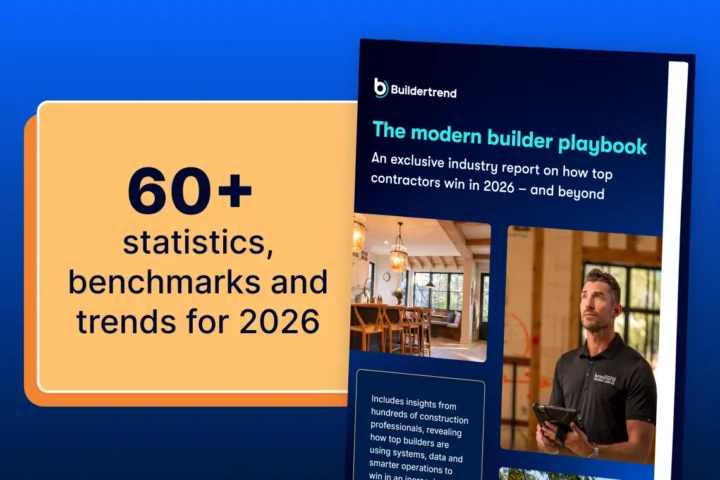
“The Modern Builder Playbook 2026” takes a deeper look at how these construction industry trends are reshaping the way successful builders operate.
Inside, you’ll learn how leading builders are improving:
- Business planning and forecasting: Moving from reactive project planning to proactive growth strategies
- Financial performance and profitability: Gaining real-time visibility and closing the profitability gap
- Communication across teams and clients: Creating more transparency and alignment throughout every project
- Supply chain and material management: Strengthening relationships and improving cost control
Each section combines real data with real-world application, giving you a clear view of what high performance looks like in today’s construction industry.
Get the full playbook
The benchmark has changed.
Download “The Modern Builder Playbook 2026” to understand how construction industry trends are reshaping builder performance – and how your business compares: https://buildertrend.com/ebooks/modern-builder-playbook-2026
FAQs on 2026 construction industry trends
The most important construction industry trends include the shift toward data-driven operations, connected systems and stronger financial control. Builders are relying more on real-time data and less on manual processes to improve efficiency and decision-making.
Construction industry trends are pushing builders to operate more like business leaders. Those who adopt integrated systems, track KPIs and manage costs proactively are outperforming competitors in efficiency and profitability.
Rising costs, labor shortages and project delays are forcing builders to improve efficiency. Tracking performance, standardizing processes and using technology are now essential to maintaining margins and staying competitive.
Builders can adapt by adopting centralized systems, improving visibility into their operations and making data-driven decisions. Those who evolve their processes will gain a competitive advantage in a more complex market.

Based on what you just read, we think you'd enjoy...
These suggestions are made by our team to help you find builders and stories that you relate to!
Back to all blogs