Redefining the client experience: How Bradford Custom Homes built a more transparent, scalable business
- From the trades to multimillion-dollar homes
- Protecting the client’s vision from day one
- From chaos to clarity with better systems
- How Bradford runs operations with Buildertrend
- Building client trust through transparency
- The ultimate benefit: Freedom to lead
- Why client experience defines the next stage of growth
Redefining the client experience is what separates builders who stay stuck from those who scale, and for many growing companies, the breaking point shows up in how the business runs day to day.
As projects get bigger, the way you manage them often doesn’t keep up. Information lives in too many places, communication gets scattered and it becomes harder to stay aligned across your team and your clients.
Brad Robinson, founder of Bradford Custom Homes & Remodeling, said that prior to Buildertrend, everything felt pulled from different places and disconnected.
The problem isn’t effort. It’s that the systems behind the work weren’t built to scale. And when your systems don’t scale, everything else gets harder.
That’s where growth starts to expose operational gaps.
Before we get into how Bradford Custom Homes solved this, watch how they redefined the client experience with Buildertrend in their own words:
From the trades to multimillion-dollar homes
Brad Robinson didn’t start with large custom homes. His path looked like most builders who built their business from the ground up. His progression reflects how many construction businesses evolve over time.
It followed a familiar path:
- Started in the trades in 2006 with a painting and drywall company
- Expanded into decks, kitchens, bathrooms and additions
- Took on larger remodels and more complex work
- Became licensed and launched Bradford Custom Homes & Remodeling
- Now builds multimillion-dollar homes across the Southeast
“I’ve been in the industry since 2006 … things have changed a lot,” Brad explained.
That growth brings opportunity, but it also raises the stakes. Larger projects mean higher expectations, tighter margins and more moving parts.
And that leads to the next challenge.
Protecting the client’s vision from day one
Bradford Custom Homes operates differently than a traditional builder. The team steps in early and helps guide the entire project from the start.
That early involvement shapes the entire build process:
- Brought into projects before architects or designers
- Helps define and protect the client’s vision from the beginning
- Aligns budget, design and timeline early in the process
- Coordinates architects, designers and trades through completion
“We’re able to digest their vision and help assemble the right team … and keep that client’s vision, their budget and timeline intact,” Brad said.
That level of involvement creates a better experience for clients. But it also requires a higher level of internal coordination.
This internal coordination is where many builders start to feel pressure.
From chaos to clarity with better systems
As Bradford took on larger, more complex projects, their systems couldn’t keep up. Information was scattered and processes weren’t standardized.
The problems became hard to ignore:
- No centralized system for tracking projects
- Inconsistent processes across teams
- Limited visibility into performance
- Difficulty scaling operations without adding chaos
“So to be very transparent, prior to Buildertrend, we weren’t really doing things well,” Brad said.
Buildertrend didn’t just organize their work. It forced the business to mature operationally.
Brad continued to explain the turning point: “Buildertrend was really the mechanism that forced our business into creating more standard operating procedures … and enhancing the client experience.”
That shift from reactive to structured is what separates growing builders from scalable ones.
How Bradford runs operations with Buildertrend
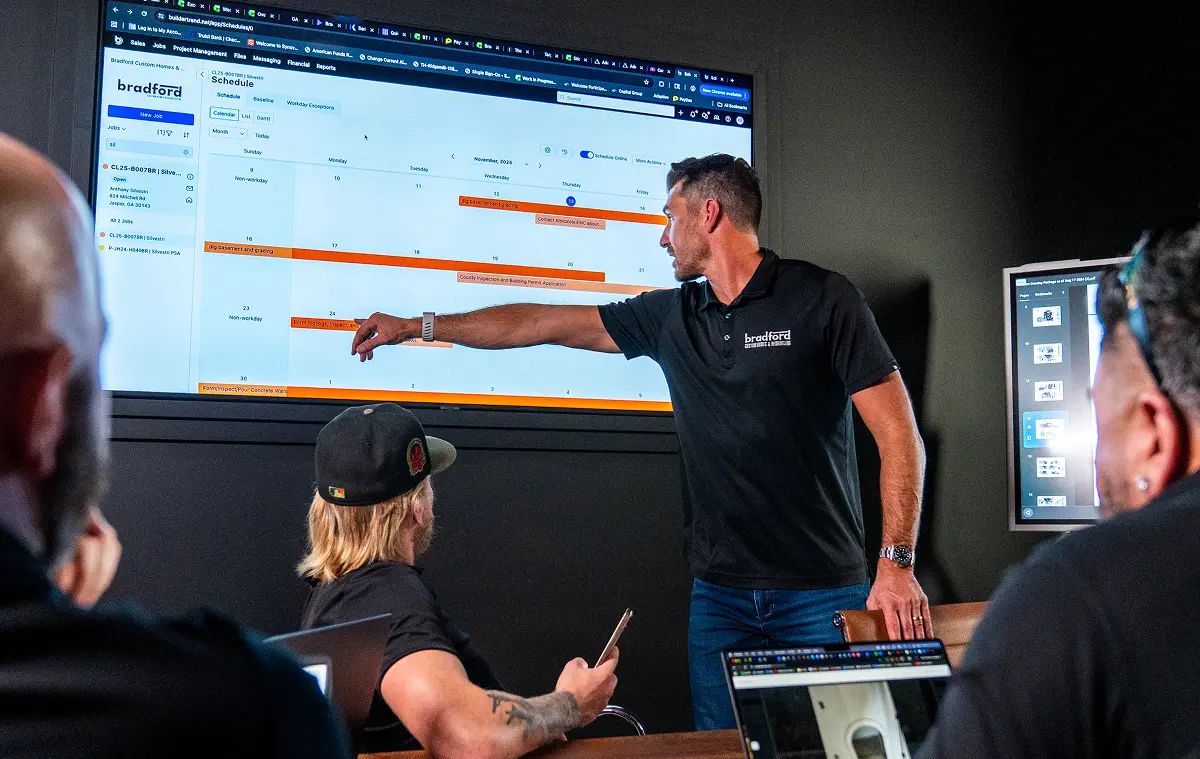
Once the foundation was in place, Buildertrend became the system Bradford uses to run projects every day — not just something they check occasionally — but how the business operates.
Here’s how they use it to stay aligned:
- Daily Logs with photos documenting progress
- Centralized project records tied to plans and specifications
- Consistent updates across the team
- Clear documentation to support quality control
“Having a central file, with pictorial evidence, making sure we’re adhering to the architecture of the house and meeting standards for the designers that we’re working with … and making sure we have evidence on a daily basis that we’re striving to adhere to it is the main goal,” said Connor Lipham, senior project manager.
Financial visibility is just as critical. Their team uses Buildertrend to stay ahead of issues instead of reacting late.
“Our project managers are utilizing that information on a daily basis, but once a week, they’re required to go in and provide a financial update … and that helps us with a 30,000 foot view of what’s up, what’s down, what’s outta sorts, and gives us the ability to get way out front of it proactively to make corrections and maintain margins,” Brad said.
These systems create consistency internally. But the bigger impact shows up on the client side.
Building client trust through transparency
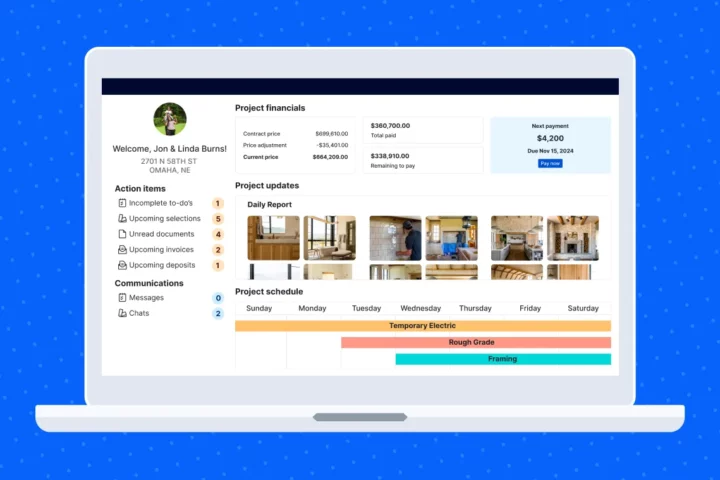
For Bradford, the biggest shift was how clients experience the build. Buildertrend turned clients into active participants on the project.
That experience includes:
- Construction daily logs showing real progress
- Live schedules clients can follow
- Built-in communication with the team
- Surveys to capture feedback during the project
- Centralized Client Portal for everything
“Our customers love using Buildertrend … from the Daily Logs to the scheduling, even to the surveys,” said Marlon Hurtado, VP of remodeling.
Transparency changes the relationship. Clients feel informed, involved and confident in the process.
“The clients really feel important when they’re being invited to be a part of the journey,” said Ryan MacDowell, director of operations.
That shift leads to measurable results: Stronger client trust, higher satisfaction and more referrals and repeat business.
And that’s what turns client experience into a competitive advantage.
The ultimate benefit: Freedom to lead
Systems don’t just improve projects, they change how a builder runs the business. For Brad, Buildertrend went beyond efficiency and gave him the freedom to lead.
That shows up in a few key ways:
- Visibility into the business from anywhere
- Ability to guide the team with real data
- Less time spent solving avoidable problems
- More time focused on the business and family
“Prior to Buildertrend, I don’t think that I would have the freedom that I have now,” Brad said. “I’m able to, at any place on this planet, look across my organization and determine what the next best action should be just to run my business on the day to day.”
Technology gave Brad the visibility and control he needed to lead the business effectively from anywhere.
“I probably would have less free time to spend with my family doing the things that I want to be doing,” Brad said. “So, Buildertrend has really allowed me to do what I want to do when I want to do it.”
And that’s what allows builders to scale without burning out.
Why client experience defines the next stage of growth
Most builders reach a point where craftsmanship alone isn’t enough. The next stage of growth depends on how well you run your business and how clients experience your process.
Bradford Custom Homes made that shift by focusing on a few key priorities:
- Creating structure across every project
- Increasing transparency with clients and teams
- Elevating the overall client journey
- Scaling operations without adding complexity
Buildertrend became the backbone that made it possible. If you’re ready to bring more control to your projects, Buildertrend can help.
Get your custom quote today and see how Buildertrend can transform your operations and client experience.
Based on what you just read, we think you'd enjoy...
These suggestions are made by our team to help you find builders and stories that you relate to!
Back to all blogs