
Economic and industry news or trends
Structure beats hustle: How documented processes drive construction efficiency in 2026

Most builders don’t struggle because they lack skill, grit or work ethic. They struggle because the company can’t run without them at the center of every decision.
This is a process problem.
The 2026 State of Residential Construction Industry Report makes one thing clear: Documented workflows, strong construction systems and repeatable project management standards are the structural advantage separating top performers from everyone else.
Non-systemized builders cap out at $2.3M in annual revenue, while systemized builders reach a median of $3.9M.
Structure isn’t bureaucracy. It’s leverage. And in 2026, leverage wins.
Why documentation shows up everywhere in performance data
Across the residential construction industry, the same pattern keeps showing up in performance data. Builders who formalize their operations outperform those who rely on memory and hustle.
The industry report draws on insights from 8,462 industry participants since 2020, making it one of the most comprehensive datasets on how top builders systemise and grow their operations. The findings consistently show that companies operating inside integrated systems deliver more predictable outcomes than those relying on informal habits.
The difference becomes clear when you look at results:
- Builders with documented workflows deliver projects on time more often.
- On-time projects finish on budget at dramatically higher rates.
- Predictable schedules reduce daily fixed-cost bleed and costly rework.
When workflows are written down and embedded into daily project management processes, everyone knows what happens next. That shared clarity drives consistency in schedule, cost and client experience. Without documentation, results depend on who is managing the job that day. With documented systems, performance becomes measurable and easier to refine.
Systems compound across the entire business
Documentation doesn’t create value in isolation. It compounds across sales, production, financials and client experience. When construction systems are clearly defined and reinforced, the impact spreads across three functions:
- Sales systems
- Clear qualification criteria prevents misaligned clients
- Documented expectations reduce downstream friction
- Project management systems
- Defined schedules and handoffs protect margins
- Subcontractors perform better when the plan is visible
- Client management systems
- Defined handoffs and communication reduce mistakes
- Fewer surprises mean fewer costly decisions made under pressure
One system reinforces the next. Strong sales filters lead to cleaner execution, which supports better financial control and creates room to grow. Systemized builders also recover faster when something goes wrong.
The report highlights a clear gap. Only 36.7% of builders maintain a documented client handbook, even though most now use professional project management software. Software without structure is just a tool. Software only becomes an advantage when it’s built into your systems.
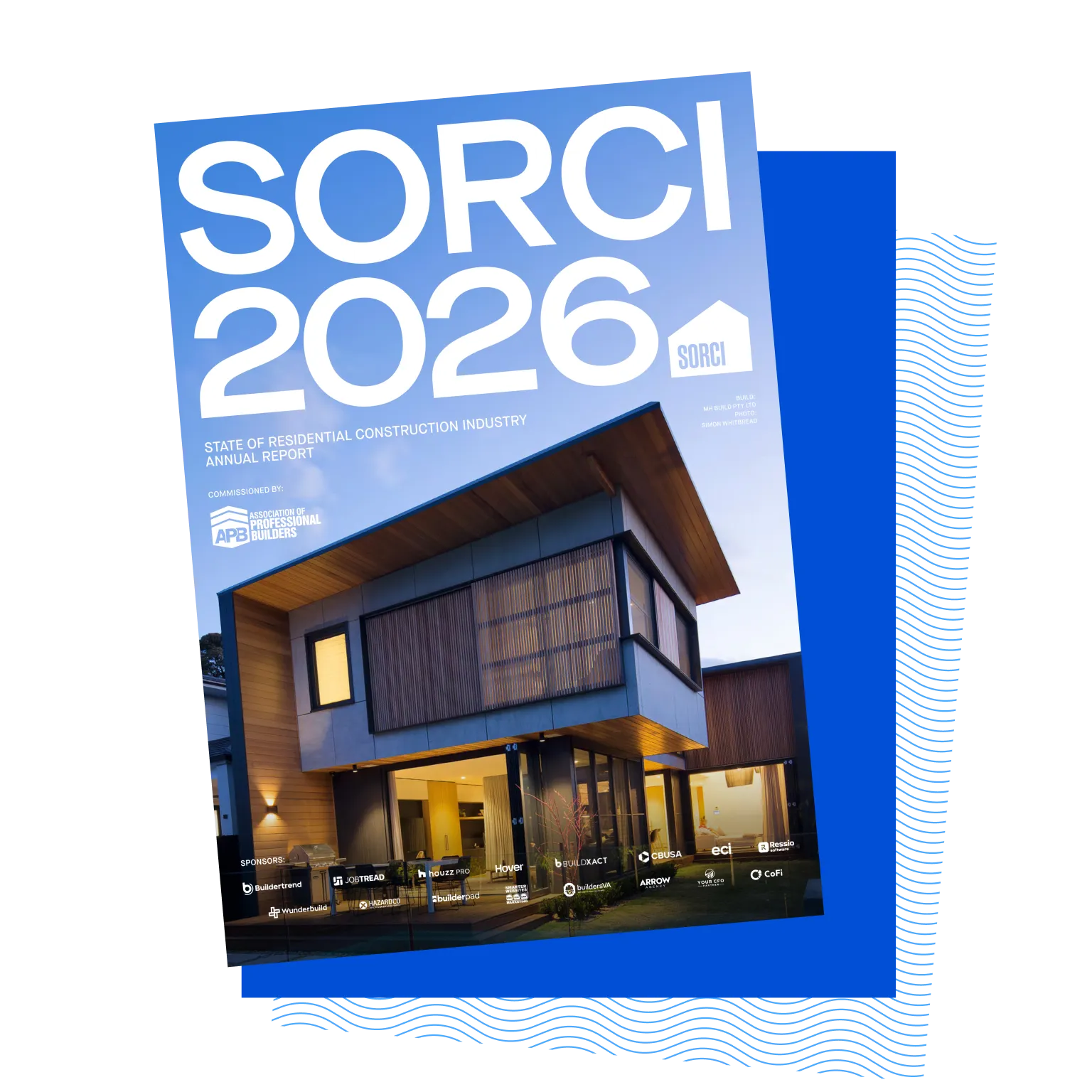
2026 State of Residential Construction Industry Report
Get the data and insights you need to grow your building company.
Why builders avoid documentation and pay for it later
Most builders know they should document their workflows. They avoid it because it feels slow when jobs are stacking up. The hesitation usually sounds like this:
- It feels like bureaucracy, not building
- “We already know how this works”
- There’s no time to slow down
The short-term speed comes with long-term cost, but the hidden impact shows up in measurable ways:
- Extra admin days clarifying scope
- Schedule slippage from unclear handoffs
- Client confusion that forces reactive decisions
- Profit lost one day at a time
This is the inefficiency tax builders feel but rarely calculate.
The data makes it visible. Builders who finished over budget carried $800 per day in fixed expenses, compared to $662 per day for those finishing on budget. When schedules drift, fixed costs keep running. Without structured construction systems, small slips compound into real margin erosion.
As projects become more complex in 2026, that erosion can accelerate.
Where modern tools turn structure into leverage.
Documentation does not mean binders collecting dust. The advantage appears when systems are embedded into daily workflows and reinforced by technology. Modern construction systems create leverage when they’re integrated into the way work actually gets done:
- Progress updates powered by AI: Reduce reactive communication and keep clients aligned without constant manual effort.
- Online payment options: Provide clearer cash flow tracking and tie billing directly to project progress.
- Advanced financial reporting: Surfaces real performance data instead of gut feel, showing where systems are working and where they’re breaking.
Instead of replacing structure, technology reinforces it.
When schedules, financials and communication live inside one connected platform, like Buildertrend, construction efficiency becomes the default. Builders are no longer relying on memory but operating inside a framework that guides decisions automatically.
And the report shows that the framework becomes harder to compete against every year.
The structural gap revealed in 2026
New industry data continues to reveal a widening gap between builders who document workflows and those who don’t. As regulatory demands, labor challenges and client expectations increase, the structural divide becomes more pronounced in key ways:
- Builders without documented systems hit predictable growth ceilings.
- Builders with structure protect margin, time and sanity.
- The performance gap widens as operational complexity increases.
This isn’t about being more organized. It’s about building a company that performs consistently without relying on crisis management.
The schedule and budget connection reinforces the point. Projects delivered on time finished on budget 76.7% of the time. Late projects stayed on budget only 51.9% of the time.
Schedule control isn’t about the effort; it’s about documented workflows that prevent drift before it starts.
Structure is leverage, not bureaucracy
The most successful builders don’t rely on hustle, memory or goodwill. They rely on construction systems that make the right outcome the default. By documenting workflows and embedding them into standardized systems, builders reduce variability and create performance that’s consistent rather than personality driven.
In 2026, the builder who runs on defined systems will thrive. The busiest builder may look successful, but without structure behind the scenes, that pace isn’t sustainable.
Explore the full 2026 industry findings
The 2026 State of Residential Construction Industry Report explores how documented workflows impact performance across sales, projects, financials and operations and why construction efficiency is becoming the defining advantage in today’s market.
Download the report to explore the full findings and see how stronger construction systems can support your growth in 2026 and beyond.
Based on what you just read, we think you'd enjoy...
These suggestions are made by our team to help you find builders and stories that you relate to!
Back to all blogs