What is inefficient project management costing your construction business?
In construction, project management is make or break. Despite that, many business owners let their company get weighed down by bad project planning. Here’s how to avoid being one of them.
Imagine we’re visiting a school build where we watch the project manager zip from one problem to another. He’s barely visible, he’s moving so fast and only stops to answer his phone – which rings a lot.
Now let’s see how things are going over another job site: a new community center. Here, the project manager leans against the truck, sipping coffee and their phone is tucked away in a pocket.
At first glance, it probably looks like the first manager is the more effective one since they’re actively doing more. But look a little closer and you’ll see the second is running a smoother project. The school has already blown through its budget, whereas the community center is set to complete early with a healthy gross profit margin for the company.
What are these two doing differently?
That’s what we’ll explore: How to go from being a typical construction company with project managers who race around like their hair is on fire … to being a construction company with project managers empowered to create calm, efficient and profitable job sites.
Could your company’s project management use a renovation?
If your business is plagued by any of the following, there’s a good chance poor project management lies at the root of the problem:
- Net profits are negative
- Gross profit margins are disappointing
- Projects take longer than planned
- Budgets are blurry
- Clients are frustrated
- Change orders derail everything
Many construction business owners hire project managers expecting them to fix all their problems, only to realize a project manager alone isn’t the solution they’d hoped for.
The approach to project management is a huge factor and poor practices can be extremely expensive. And not just in immediate dollars lost to budget overruns or lacking profits, but in the subsequent stress, disorganization and frayed relationships that can have a costly impact for years afterwards.
What is the construction industry doing wrong?
It’s important to know if your business is dealing with sub-par project management, the situation is not entirely your fault. As an industry, construction hasn’t been great at keeping up with standard practices.
Generally, construction project managers are working without defined or industry-specific processes and are just left to wing it, making things up as they go. It’s an unfair starting position, especially given the many unique challenges faced in construction – burdened with bureaucracy and labor shortages, where each job is like embarking on an adventure with a new site and new crew.
Unfortunately, most construction companies are either unaware of this predicament or aren’t investing the effort, time and resources necessary to turn things around. Which means … there’s opportunity for those companies who do (hint, hint).
How did construction project management become so dire?
We didn’t get here overnight. The story goes back a long way, as you can imagine. To shed some light on how this happened, indulge us a little history lesson …
Basically, project management has three eras:
- 1900 – 1950: The era of productivity: These years were focused on getting each person working as efficiently as possible, with planning and doing viewed as separate endeavors.
- 1950 – 2000: The era of predictability: These years gave rise to the iron triangle of cost, schedule and scope. Project managers became more focused on administration, almost more planners than managers. You could call this the beginning of the end.
- Present Day: The era of profitability. Today, project management is more about the “holistic how.” As in, how do we deliver our objectives the most cost effectively? How can we manage projects differently?
If you’re interested in the history of project management (and who isn’t?), we recommend checking out a book called “Built to Fail: Why Construction Projects Take So Long, Cost Too Much, And How to Fix It” by Todd R. Zabelle.
Fixing dysfunctional project management systems isn’t complicated. But your PM can’t do it for you. Discover how to take charge of your project management systems so they’re productive, predictable and profitable. Watch this roundtable for 7-figure builders.

The costs of bad construction project management
According to a labor productivity report released by FMI, upwards of $30 billion dollars were lost in 2023 due to poor productivity – aka, poor project management. And most respondents figured that about 11% of field labor costs are completely wasted. Yikes.
So, what’s driving these figures? The FMI identified three areas of deficiency:
- Planning
- Communication
- Collaboration
Poor productivity carries knock-on effects. If you’re managing projects inefficiently, it takes longer to finish jobs and payments are slow to come through the door. You can’t move on to another project and maybe miss out on potential revenue.
There are also impacts on your business development. If a project runs over, the client is unlikely to walk away from the experience impressed, which means they’ll look elsewhere when the next opportunity comes around. The easiest customer to sell to is the one you already have. When you’re on a job, you’re not just building a project – you’re building a client relationship. And relationships are priceless.
Lean into lean construction
To get your project management on track, it’s well worth exploring lean construction. This approach flips the typical model of project management on its head. Instead of being a distanced system where decisions happen far from the realities of the job site, lean construction brings those realities into the room early in the process.
Let’s look at how it addresses the three biggest project woes:
Planning
The project manager is no longer just an administrator, but is truly empowered to delve into the nuts and bolts of the job right from the start. The last players normally involved in the work are now the first to be engaged in discussions, and the planning proceeds backwards from there.
Communication
Managers tend to think they’re communicating all the time because they’re constantly talking to the city, vendors or customers (for the record, angry phone calls don’t count). But here, communication is deliberate and follows a plan. It’s regular and encompassing, setting a tone that radiates through the rest of the project.
Collaboration
When people feel respected and part of the process, they work more cohesively. So when the HVAC subcontractor is asked what they’ll need and when in order to ensure a smooth handoff, you can bet they’re going to give you their best when it’s their turn to step up to the plate.
What are some traits of good and bad project managers?
The best project management system in the world will only ever be as effective as the person in charge of implementing it.
To that end, here are some red flags to watch for that could signal your project manager is maybe not the best fit for your job:
- Demotivated: They can’t be bothered to do the job at all, let alone do it well.
- Pitiful team player: They don’t work well with others. (Collaboration is key, remember?)
- Quick-tempered: They need to be able to keep their cool, especially when the road gets rocky.
- Bad juggler: No, we’re not talking about their circus skills. We mean their ability to keep a lot of plates in the air without getting easily overwhelmed or discouraged.
On the flip side, if you encounter any of the following qualities in a project manager, hold them close and never let them go:
- Super in sync: They’re eloquent and articulate, practically psychic they’re so good at conveying a message.
- Tough as nails: Project management involves having tricky conversations and holding people accountable. They aren’t phased by either. And the best part? They hold themselves to the same standards.
- Masterful: They understand the craft as well as those doing it, which comes in extremely handy when there are problems to solve. They’re as comfortable in the field as they are in the office. Arguably more so.
- Thankless leader: They put the team first, taking on the tasks no one else sees or truly appreciates. Not only do they not complain about it, they quietly elevate everyone around them.
Project management shouldn’t be taken lightly
In construction, particularly, it’s fundamental to your bottom line and the success of your company. An effective system with a star project manager at the helm can mean the difference between scaling your business to new heights or remaining stuck in the muck.
It also helps to have some cutting-edge tools on your side. Buildertrend’s seamless platform offers the ability to track every aspect of your project and ensure delivery is on time and on budget (if not better).
Breakthrough Academy’s Goal Setting & Review system has helped hundreds of contractors keep their teams accountable and their projects on track.
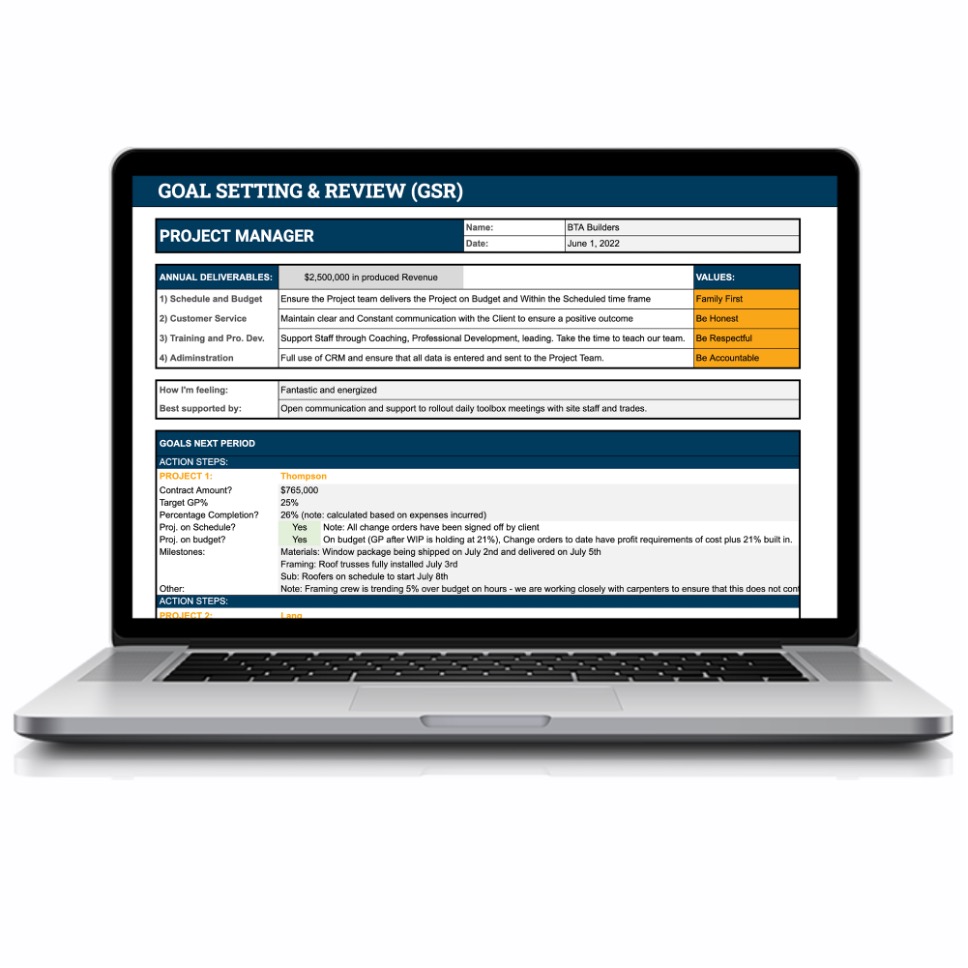
Curious how improving your project management could enhance your business? Join Buildertrend with Breakthrough Academy for a Project Management Roundtable to discover how two elite builders dialed in their project management practices and grew their businesses to record profit levels. Watch now.


Based on what you just read, we think you'd enjoy...
These suggestions are made by our team to help you find builders and stories that you relate to!
Back to all blogs