




Let’s get real: Customers share their honest feedback live with our Product team
This episode was recorded in 2024. Because Buildertrend continues to improve and expand its platform, some features or services mentioned may have changed.
On this episode of “The Building Code,” Zach and Charley are sitting down with industry leaders Heather and Steve Tankersley, co-owners of Tankersley Construction, in front of a live audience at Buildertrend headquarters. As long-time users of Buildertrend, Heather and Steve know what it takes to be successful with the platform – but that doesn’t mean they think it’s perfect.
Tune in to this special episode to hear the Tankersleys answer questions directly from our Product team and share their candid responses on what works and what doesn’t when it comes to Buildertrend’s software.
How has Buildertrend helped with the evolution of your company?
Heather: “I think for us, it was scale. Because if you’re not growing, you’re dying. So, why wouldn’t you push yourself to be better? Why wouldn’t you push to keep exploring how we do this process better? We’re very oriented in both how we approach projects, and we ask our team ‘What did we do right? What did we do wrong? And what are we going to change?’ Because that’s the only way you’re going to get better. You’re going to get better as a company, you’re going to get better as an individual, an employee. And what’s the experience going to be for the customer? No different than what Buildertrend does.
Steve: “We never wanted to just be a $1 million remodeling company. And so, if you just want to be a $1 million remodeling company that does five jobs a year, you could probably run it pretty well on Excel. It could be better, but if you want to actually grow, you’ve got to have the framework in place to be able to grow smartly and responsibly. Buildertrend has given us that. At any given time, we’ll have 20 active projects, whether they’re in warranty, pre-construction or construction. And we can run all those jobs at one time to see where they’re at, schedule, financial, everything, so I don’t have spreadsheets everywhere.”
Is there any feedback you have for how the software could work better?
Heather: “I think the thing that’s challenging for us on the production side of it is getting subs bought into it. Our subs utilize it, and it’s great, and we push that on our end. I think it would be great if we were able to make that interface happen. Our cabinet maker, he’s a Buildertrend customer. He does a daily log on his side. Why can’t I see his daily log? I’m already calling him going, ‘Hey, this door alignment’s off on these cabinets.’ ‘Yeah, I know my guy already did a daily log, and I saw it. I’ll have them there tomorrow.’ Right? So, just the amount of phone calls I wouldn’t have to make to him. He’s obviously a paying customer to Buildertrend, and so are we. Why can’t we see those things together?”
Steve: “I think, first of all, you guys are doing a great job. You built an amazing product. What I look at is where else are we spending money for other platforms that you guys can just do, and we just have one platform? I’ll pay more money for it. That’s not a problem. It’s just less things we have to keep track of. We use a separate app for crew scheduling. When I say crew scheduling, it’s like José the carpenter has to be at one job for two hours in the morning, then four hours, and then two hours. Right? In a robust crew scheduling platform. There’s tool inventory management. We have a separate app for tool inventory management at our company and are able to barcode things. If we could have that in there [Buildertrend].”
Links and more
Learn more about Tankersley Construction.
Have feedback for our Product team? Leave your suggestions here.
The 2024 State of the Residential Construction Industry report is now live. Get builder insights and data from across the globe with best practices in marketing, sales, financials and operations. Download the report now and make it your most profitable year yet.
Related content:
Listen to the last episode as Zach and Charley go guestless to talk about a couple Buildertrend topics they’re truly passionate about.
Subscribe here, and never miss an episode.
Got podcast topic suggestions? Reach out to us at podcast@buildertrend.com.
The Better Way, a podcast by Buildertrend:
Looking to add construction tech to your daily processes? On the newest season of “The Better Way, a podcast by Buildertrend,” you’ll get best practices for implementing software and getting your team on board from other industry pros and our experts. Subscribe and stream today wherever you listen to podcasts.
Follow us on social:
Listen to “The Building Code” on YouTube! And be sure to head over to Facebook to join The Building Code Crew fan page for discussions with fellow listeners.
Zach Wojtowicz:
What’s up everybody? Welcome to “The Building Code.” Zach Wojtowicz here.
Charley Burtwistle:
Charley Burtwistle here.
Zach Wojtowicz:
Buddy. Little bit different day today.
Charley Burtwistle:
We made it.
Zach Wojtowicz:
It finally happened.
Charley Burtwistle:
It finally happened. We have been asking to do something like this for a long time. If you’re listening to the audio, we are here live at Buildertrend, in front of about 150 Product and Engineering folks. Can you guys say hi?
Zach Wojtowicz:
Wow. Charley, I do want to, you talked about this in the pre-script, you recently got married.
Charley Burtwistle:
I did get married on Friday, but I wasn’t able to fully enjoy it or think about it too much because I knew I had today coming up. This is the real big day.
Zach Wojtowicz:
The one big twist that we didn’t reveal, and I’m glad you didn’t, was you actually had your reception here.
Charley Burtwistle:
At Buildertrend.
Zach Wojtowicz:
At Buildertrend.
Charley Burtwistle:
I did. Yeah.
Zach Wojtowicz:
So, what’s it like playing on Friday? I assume there was speeches given on this stage and now, we’re having “The Building Code.”
Charley Burtwistle:
I know. Someone asked me when we were back there like, “Oh, are you getting flashbacks from your wedding?” I’m like, “I work 40 hours a week in this building, so if anything” …
Zach Wojtowicz:
What’s another five to six?
Charley Burtwistle:
What’s another five to six? And it was great. I took a break right after my speech, I went up to the boardroom, got some work done, really optimizing my time.
Zach Wojtowicz:
I actually would love to see a Tableau report on the screen during your best man speech.
Charley Burtwistle:
Yeah. Yeah, Charley’s love over time or something like that. All right, that’s enough of Zach and I. We have two very, very special guests today also joining us live in-person out in Omaha, all the way from beautiful California, Steve, Heather. Thank you guys very much for being here.
Heather Tankersley:
Yeah, thanks for having us.
Steve Tankersley:
Thanks for having us. Is this your honeymoon?
Charley Burtwistle:
Yes, this is my honeymoon. Yeah. So, thank you guys for joining us. This is a first ever. You guys are kind of inaugural guests in the live version of “The Building Code.”
Heather Tankersley:
No pressure.
Charley Burtwistle:
No pressure. I was looking at your guys’ itinerary. You’re here for two days, and I think they have every single minute of your time booked with some sort of meeting or podcast, so thank you guys so much for being here and making time for us.
Zach Wojtowicz:
Yeah. We wanted to make sure that we just rolled out the red carpet for you all, so you have the great experience that we’re hoping. Steve and I actually just did a webinar as well. We spent a lot of time together. We’re going to dinner tonight. You’re going to have to be like, “All right, enough of Zach. That’s enough.”
Well, one of the things that we wanted to bring you on today and why we’re doing it live is this is our Product and Engineering team. These are the people that are responsible for bringing the product to our wonderful customers and I spent a lot of time talking to our customers. We’re working with John Walker, which he’s been talking, he’s our biggest fan of “The Building Code.” He wanted to find a way to bring in customers to the Product and Engineering meeting, and so we felt like this would be a great way to do that. So, it’s really exciting to have your guys’ perspective on the product and really get into our process about how we bring the product to you as well. We’re even going to do a live Q&A just off the cuff, just see what you think. So, please don’t hold back. Just let it rip, all right? No pressure on your end, especially with all the engineers watching us. It’s one thing to hear it in a report where it’s like, yeah, this kind of sucks, and now it’s like, okay, what do you actually think here?
Charley Burtwistle:
Tell us what you really feel.
Zach Wojtowicz:
Yeah, tell us what you really think. And there’s obviously really great things, too. So, let’s start with your company. Just tell us a little bit about your journey, how you came to Buildertrend and why did you go with Buildertrend over other competitors in the construction management space?
Heather Tankersley:
You want to field that one?
Steve Tankersley:
Yeah, I think Heather, and I each have our own story and we meet somewhere around 2008. I don’t want to give you the whole story. Backstory, I got into construction. My dad was a plumber, Chuck In A Truck, and he told me in high school, he’s like, “Don’t go in the trades.” I probably should have gone in the trades, but I didn’t, I went to college. I remember, I went to Sacramento State University, and I remember trying to pick a major. I was scrolling through all the majors, and there’s business, there’s communications, all this stuff. There’s this thing called construction management. So, it’s construction, I love construction, and management, right? So, that’s cool.
Zach Wojtowicz:
Those are words.
Steve Tankersley:
Yeah.
Charley Burtwistle:
Yeah.
Steve Tankersley:
I don’t know. I was 17, made sense. I didn’t realize construction management was actually engineering degree, and I hated math, and I had a hard journey through college. I should have a doctorate. I went through seven years of college, and I graduated with my degree in construction management. During that time, I worked in commercial construction, I interned with a lot of companies and took that traditional path and worked for a commercial construction company. During that time, that was like 2006, 2007, 2008, I met Heather in 2009 and …
Heather Tankersley:
We met on a job site, just to clarify.
Zach Wojtowicz:
Oh.
Steve Tankersley:
I’ll let her clarify on that whole story. We met in 2009. She worked in commercial construction, I worked in commercial construction and from there our relationship grew. With commercial construction, if you’re not familiar with the industry versus residential, it’s completely different. There’s very complex projects, $100, $200 million projects. I worked on a $500 million power plant, just a concrete package was $80 million. These jobs took us all over the country. Or all over the state, I’m sorry. Sometimes all over the country. As we started having kids we’re like, “Hey, one of us, we can’t both be doing this.” I was really unhappy in my job, I’m very ADHD type, and I just was not a good employee. And I got a job.
Heather Tankersley:
That’s true. That is true.
Charley Burtwistle:
Yeah, we said brutal.
Zach Wojtowicz:
Harsh truths.
Steve Tankersley:
I was working on a-
Zach Wojtowicz:
We said, be honest, so.
Steve Tankersley:
Yeah.
Heather Tankersley:
We’re going full honesty mode right now.
Charley Burtwistle:
Yeah, just go full on.
Zach Wojtowicz:
I stumble with chores.
Steve Tankersley:
Backing up from there, I had this job and Heather goes, “You’re not going to last it a year there.” I made it a year. Made it a year.
Heather Tankersley:
Real supportive wife. Don’t worry, I’ll give your wife some tips later.
Steve Tankersley:
I got let go from my job, and I was driving home, and I had my contractor’s license, I had a website built for this company that I was going to start one day and never had the courage to really start, I was doing work on the side and she goes, “Just go for it. You have your license. Just make the website live and you’re there.” I did it and had some faith. At the same time, Heather was pregnant, so picture us, we have a two-year-old at home, she’s five months pregnant. Just lost my job, had about $5,000 in our savings account, this was 2017, had an old truck, and we started the company. We were fortunate was getting some large projects early on and really taking care of our clients and building on that reputation.
One of the biggest challenges we had, and I won’t get too far down the road, was just trying to integrate the company and integrate the processes we had in commercial construction to our residential company. So, that’s my perspective of our journey. I’d like to hear Heather’s, too.
Charley Burtwistle:
I definitely want to hear more about that first meeting. I feel like we glanced over that real quick.
Heather Tankersley:
We glazed over that, yeah. No, real quick.
Zach Wojtowicz:
There was a skid loader, some framing.
Heather Tankersley:
Yeah. Yeah, no, it was a bridge actually.
Charley Burtwistle:
Oh, romantic.
Zach Wojtowicz:
Love that.
Heather Tankersley:
It was great. It was very romantic, yeah. Yeah, I think we were actually redoing the pump house.
Steve Tankersley:
No, we were adding a toilet to a culvert.
Heather Tankersley:
Exactly. It was very, very beautiful.
Steve Tankersley:
It was a very complicated project. It was a drawbridge on the California Delta, but it was just a toilet.
Heather Tankersley:
Yeah. Yeah, it had to be done at night. Yeah, it was a whole thing. So, my background, I actually got my degree in actually marketing and public relations, worked for electrical contractor in 2008, ’07. And yeah, 2008, nobody needed a marketing department, so they were like, “Great. We like you, but yeah, we don’t need a marketing department anymore, but we’re going to move you to construction. You’re going to get to go build packages.” And I knew nothing about construction. It was great.
So, I moved over to that team. I ended up really falling in love with construction, figuring out all the ins and outs. Ended up going back to school and got my certificate in construction management. Worked my way up, worked for the largest electrical contractor in California as a project manager, and met Steve. I cashed in when stock was low, he was still in school. I was a project manager.
Steve Tankersley:
Stock’s an all-time high right now.
Zach Wojtowicz:
You took a …
Charley Burtwistle:
Yeah.
Heather Tankersley:
Yeah, an all-time high. We were going.
Zach Wojtowicz:
You took a flyer.
Heather Tankersley:
I did.
Zach Wojtowicz:
I love it.
Heather Tankersley:
And I was like, hey. So, yeah. Then, I was running work all throughout California. When we started the business, I was actually on maternity leave. I actually got the date handed to me today. I had a five-week-old baby, we had employees, and I needed to figure out how I could get their time into a time card for all the time that I could be able to work on the business while I had a 2-year-old and a five-week-old. So, I actually had my first intro with Buildertrend in 2018 when, yeah, I was at home on maternity leave. That’s when I decided, great …
Zach Wojtowicz:
I should Google construction management software.
Heather Tankersley:
Yeah, that’s exactly how it went. Yeah, I had my whole intro. I think we figured out my baby was five weeks old. So, yeah, I worked that in on a nice demo. But yeah, that’s how we ended up with our processes and platforms in our company. We kept going with the business. I still kept my job. I didn’t move over full-time to the business till 2019, still running work, hospitals, prisons, all that kind of stuff. So, really we took what we knew in commercial construction and we brought it over to our business and integrating all the options that Buildertrend has for us.
Zach Wojtowicz:
I love that. I feel like when we have people on the podcast here, there’s two distinct camps of where people came from in their construction journey. One is like, I took over my dad’s business when I was old enough, and you guys I think is the much more fun story of we kind of accidentally fell into this and figured it out as we went, took a shot, launched this thing, and obviously, very, very successful up to today. So, just to set the context a bit more before we get into the nitty-gritty, can you tell us a little bit more about Tankersley Build as it exists today? How many employees do you have? How many builds are you doing? Just to set the framework for the rest of this.
Heather Tankersley:
Yeah. Currently, we have 10 employees. We have in-house carpentry that we self-perform, so we have three in-house, carpenters, operations manager, production manager, office manager. We actually have a new PM who’s starting with us in a couple months. So, that’s what we, in terms of staffing side, plus Steve, myself, and our estimator. We do typically around 15 to 12 jobs a year. It depends on the contract value and size, and we’ll do one custom home build a year. Anything else? No?
Steve Tankersley:
No. We do some commercial work.
Zach Wojtowicz:
You still do?
Steve Tankersley:
We probably do one commercial project a year. Really the mission for us is we build cool stuff for cool people. So, if you’ve got a cool project, and you’re a cool person, probably a good fit, right? We have a little more dial than that, but honestly, we’d build a dog house for someone if there is a cool enough dog house and a cool enough person, and they have the budget for it.
Heather Tankersley:
And it’s over $100,000.
Steve Tankersley:
Yeah.
Zach Wojtowicz:
Man, prices is a California.
Heather Tankersley:
A very complex dog house.
Steve Tankersley:
$100,000.
Zach Wojtowicz:
$100,000 dog house.
Steve Tankersley:
Yeah, there’s an ideal market for that.
Zach Wojtowicz:
What’s the market on Zillow.
Heather Tankersley:
And we really thrive in a larger scale addition, kind of a complicated build. We’re going to blow out the back of your house, we’re going to do a steel beam. We’re not doing just a kitchen at this time, right? Obviously, everyone has to start somewhere. That’s what we were doing. You got to ramp up. You can’t just take on all the cool, sexy projects first. But I would say our bigger jobs now, everything’s over about $500,000 in contract value at this point.
Steve Tankersley:
Yeah.
Zach Wojtowicz:
This is the part of the interview where normally we take the bait, and we get off script, and we get yelled at. So, I’m going to keep it on script here and talk a little bit about Buildertrend when it comes to your evolution of it. So, you Google it, 2018, you find construction management software. Buildertrend obviously at the top of the list, you try it out. The interesting thing is a lot of people when they try a construction management software, they end up moving on and saying, “I’m going to go back to our actual competitor,” which is Microsoft Excel or manual methods because that’s their habit. So, why did you guys end up staying with Buildertrend? What was it that led to your evolution? You’ve got your commercial contracting background, you want SOP, so why Buildertrend, though, when there’s also plenty of options out there?
Heather Tankersley:
Because Heather said so. No.
Steve Tankersley:
No, I mean, I …
Zach Wojtowicz:
That’s what it takes. We call that the BT champion, everyone.
Steve Tankersley:
I think it’s important to consider the context of our business history. We started in November, just 2017. Our first project was in November, we finished it in February of 2018. We signed up with Buildertrend in May of 2018. So, we weren’t a 10-year-old established company with these processes ingrained that a lot of companies struggle with. We were pretty open to stuff.
Heather Tankersley:
There’s no bad habits. We didn’t have bad habits to break yet.
Steve Tankersley:
Yeah. I came from a company that was using competitor, we used some pretty antiquated software. I’m not going to name it, but it was really difficult to use at commercial construction, but it had the functions we needed. But it was very hard to use. And so, when I came on here, I just needed some, I had clients, I needed a schedule, I needed daily logs, and I really needed a database for all my trade partners. Because it was getting out of hand where I had four drywall guys and three plumbers, and I couldn’t remember all these guys’ names. They’re in my phone.
Heather Tankersley:
Joe, the drywall guy. That’s it. Yeah.
Steve Tankersley:
Yeah. I still have these in my phone. I just type drywall, it’s like Joe, drywall guy. I don’t even know who this is from like five years ago.
Zach Wojtowicz:
It’s Joe. Joe.
Steve Tankersley:
Yeah.
Heather Tankersley:
Heaven forbid he has a …
Steve Tankersley:
Having that database for all my subs, that was crucial for me running projects. But also, remember Heather was running the financials on the backend and the timecards and doing the payroll at night, and so, that was a different thing for her. But for me, I kept with it because my clients had a schedule. I was able to ditch Project and Excel for schedules because what I was doing was building a master schedule and project. When I first started, actually a bootleg project, I didn’t even pay for it. I think I downloaded it for free somewhere. Then, I would do Excel little look ahead schedules and so, having that was great. And then having that database of subcontractors and doing that sub trade invites for us, that for me, that was critical early on.
Heather Tankersley:
Yeah, I agree. I think for us, you mentioned the time clock feature and getting payroll pushed through. It wasn’t until 2019 that I moved over. So, half the time I’m not going to be able to track down a time card from somebody at nine o’clock at night on Sunday when I’m getting to payroll. Same thing with sub payments. Did we pay the sub? Did we not pay the sub? Is that what we’re supposed to pay them? Right? Utilizing the PO features and stuff like that. And making sure that we’re paying what we said we were going to, and we’re not paying them more than we should.
So, that was really, for us, just working through those processes. And knowing what we know, we need a process. Right? How do we do that? How do we execute that? I don’t think you go into business like, oh, I got it all figured out, right? Everybody’s flying by the seat of the pants and trying to figure it out, we call it build plane as you fly. So, we’re trying to make all these things happen with the nuts and the bolts falling out, and how do we do that? Having at least a system to say, okay, this is where everything’s going to live, this is how we’re going to execute the job and then build from there.
Steve Tankersley:
Yeah.
Charley Burtwistle:
What I’m really interested to hear, is I feel like what you guys described sounds pretty common why most people sign up. We have one specific pain point that they’re looking to solve. They find the solution, they dive into that. Then, the two forks in the road there is are we fine with settling with just the core functionality, the reason that we signed up? Or Buildertrend, obviously, a very, very robust system, do we continue to train and adopt new features and go outside of what we’re just looking for and really optimize how we’re using the system?
You guys obviously are sitting up here today because you use our system very, very well. One of our influencers, you’re here in HQ meeting with our entire c-suite, meetings with Zach. You guys are the best of the best. So, I’d love to hear from your perspective for potential clients listening to this, and also, obviously, our engineering folks here today, is what did it take for you to continue to push yourself to adopt more and more of the platform and not just settle for, “Okay, now we have our subcontractors in the schedule, which is what we were originally looking for?” How did that continued evolution look?
Heather Tankersley:
I think for us, scale. How are you going to scale? If it’s only we’re just going to utilize the schedule but I have this tool, how is somebody besides me, myself or Steve going to be able to do this? If we’re going to have a team, if we’re going to grow? At the time when we integrated it, we had two employees, three employees. So, when you look at it from the bigger scale, I think our background helps with that as well, right?
Steve Tankersley:
Right.
Heather Tankersley:
Knowing that there has to be some place for this to go and to be able to keep diving into it. Because if you’re not growing, you’re dying. So, why wouldn’t you push yourself to be better? Why wouldn’t you push it to keep exploring how can we do this process better? We’re very oriented in both how we approach projects, and we ask of our team “What did we do right? What did we do wrong? And what are we going to change?” Well, we start with that, every job we do a Plus-Delta at the end. What went well and what can we change? Because that’s the only way you’re going to get better. You’re going to get better as a company, you’re going to get better as an individual, an employee. And what’s the experience going to be for the customer? No different than what Buildertrend does.
Steve Tankersley:
Yeah, I think one critical thing for us as a company is, it’s not about how much work we do. We never wanted to just be a $1 million remodeling company. And so, if you just want to be a $1 million remodeling company that does five jobs a year, you could probably run it pretty well on Excel and just your typical things. It could be better, but if you want to actually grow, you got to have the framework in place to be able to grow smartly and responsibly. Buildertrend has given us that where we can run, we’ll be running any given time, we’ll have 20 active projects, whether they’re in warranty, pre-construction or construction. And we could run all those jobs in one time to see where they’re at, schedule, financial, everything, and to see that hub, so I don’t have all these spreadsheets everywhere.
The big driver for us to keep pushing, honestly, a lot of that has been on Heather’s end, delving into the financial side. We did a lot of that in 2020 when we were shut down, and a little bit of the story there. But just really opening up the financials in Buildertrend. Because at that time in 2020, we were about a $2.4 million revenue company. We were a quarter of what we are right now. But by getting that set up, it gave us the framework to be where we’re at today, four years later.
Heather Tankersley:
Yeah. How are you going to stay organized? How are we going to execute on more projects, more complex projects, without having those systems in place and utilizing the features to do that?
Zach Wojtowicz:
It’s really interesting. Charley and I, when we have guests on the podcast, this comes up a lot. You have the growth mindset. You went into this around having a vision of, I know I can get here with processes. Do you feel like Buildertrend has been able to accommodate your growth? Or did it help enable your growth faster? What was the impact of the product in order you to achieve these visionary aspiring type mindsets that you have going into business?
Heather Tankersley:
You want to go?
Steve Tankersley:
Yeah. I think having Buildertrend, yeah, the answer is yes. It’s a piece of it. We’re involved in a lot of things, in peer mentoring and networking on a local and national scale. All those are pieces of it. But having this process, and number one, if you’re selling to high net worth individuals, executives, people who own their own businesses, having a platform like this puts you head and shoulders above the people that they’re talking to. So, if you’re trying to build, well, we just finished a $4 million home and the owner is a very large tech vice president. Having that platform for him was no question, I want these guys. So, that has allowed us, just having the platform and using it has allowed us to really attract that clientele.
Heather Tankersley:
We get that …
Steve Tankersley:
You can’t fake it.
Heather Tankersley:
Yeah.
Steve Tankersley:
You can’t just have the software and then they keep getting Excel spreadsheets during construction. You actually have to do it.
Heather Tankersley:
Yeah. That’s across the board, right? I think we use it in sales and clients look at it and they’re just like, “Wow, that’s amazing. We love that. We love that you have that. We love that you show an active job you have right now.” We had somebody, we showed them the Daily Log feature and we brought it up and there was a picture on the daily log. They’re like, “Oh, did you stage that photo for the daily log for how clean the site is?” No, that’s what it looks like. This is what we actually do, and that comes from the top down. This isn’t just Steve and Heather pushing this and the team’s not bought in, right? The subs have to be bought in, our employees have to be bought in. Our employees have to realize that it has a benefit as well. And so, it can’t just come from us. That’s what we push from the management standpoint, but the team buys into it as well.
Charley Burtwistle:
Yeah, so Zach took the layup question there of does Buildertrend help your guys’ business?
Zach Wojtowicz:
Hey, man, you’re slow on the mic.
Charley Burtwistle:
Yeah, I know. So, now I get the next one, which is what areas you want to see improved.
Zach Wojtowicz:
It’s the audience. It’s all right. Hey, you’re doing great.
Heather Tankersley:
Oh, yeah, blame it on us. Yeah, yeah.
Charley Burtwistle:
No, I think the Product and Engineering team that we have here today has done a fantastic job. I’d say our company as a whole, the past few years has had this tagline focus on the customer, focus on the customer. And the people in the crowd today have really been leading from the front. They do customer interviews, they do customer ride-alongs. Every single thing that we put into the product was because they talked to a customer. So, this may be the most direct and live and recorded feedback that we’ve ever had, but it is really, really important as we continue to build for our customers is to get that customer feedback.
That was my nice way of teeing up this question of what things are you looking for for improvements in the features and functionality of Buildertrend? Is there something that you really wish we had added? Is there an area that you wish could be improved a little bit? We cleared this with our marketing and PR team before this. We want harsh and honest truths here. So, this is your opportunity to vent or provide suggestions a little bit on what you’d like to see improved.
Heather Tankersley:
I think we’re each going to give different feedback. Oh, wait.
Charley Burtwistle:
Perfect.
Heather Tankersley:
So, I run all the operations and production side, so all the construction crews, some contractors in the customer portion of it during a build. So, we’re going to have different feedback for this, I think, from how we each utilize the software. Steve handles all the estimating and sales, so he’s going to probably rip into the estimating template. I think for us, I think the thing that’s challenging for us on the production side of it, and I was telling somebody earlier when they were asking, is getting subs bought into it. Our subs utilize it, and it’s great, and we push that on our end, but that’s a constant. Again, back to we need to utilize this, this is where we’re all going. I think it would be great if we actually were able to make that interface happen. We have subs, we have our cabinet maker, he’s a Buildertrend customer. He does a daily log on his side. Why can’t I see his daily log? I’m already calling him going, “Hey, this door alignment’s off on these cabinets.” “Yeah, I know my guy already did a daily log, and I saw it. I’ll have them there tomorrow.” Right?
So, just the amount of phone calls I wouldn’t have to make to him, or I’m making him a to-do. The giant joke, he actually did it at our panel at IBS. He made me a giant sign that was like, “I love a to-do from Heather.” So, I’m making him a to-do, and he’s like, “Great, thanks, appreciate that. Awesome. Yeah, I already got the alignment.” So, that’s one of the challenges because he’s obviously a paying customer to Buildertrend, and so are we. Why can’t we see those things together? Knowing that, I think the notifications to everybody, I always get that feedback of, “Yeah, I don’t even pay attention to that. I got 14 notifications.” So, that’s turned into a challenge for us, too.
Steve Tankersley:
I think, first of all, you guys are doing a great job. You built an amazing product.
Heather Tankersley:
Oh, yeah. Sorry. Probably should have started with a compliment.
Zach Wojtowicz:
Heather just went right in. She did not hesitate.
Heather Tankersley:
I just laid into you guys. Sorry.
Zach Wojtowicz:
Steve backed it up.
Heather Tankersley:
Yeah, sorry.
Zach Wojtowicz:
You guys are great.
Steve Tankersley:
I’m one of those guys.
Zach Wojtowicz:
Please don’t storm the stage.
Steve Tankersley:
I’m sure a lot of you guys get friends like, “I got a great app idea. I got an app idea. Can you build it for me?” I’m sure that’s the thing.
Zach Wojtowicz:
We love ideas. Just start pitching app ideas right now.
Steve Tankersley:
And there’s so much work that goes into all this stuff. So, I think you guys are doing a great job. What I look at is where else are we spending money for other platforms that you guys can just do, and we just have one platform? I’ll pay more money for it. That’s not a problem. It’s just it’s less things we have to keep track of. There are some key points, and I brought it up before and bringing it up today, too, and it’s crew scheduling. Right? We use a separate app for crew scheduling. When I say crew scheduling, it’s like Jose the carpenter has to be at one job for two hours in the morning, then four hours, and then two hours. Right? In a robust crew scheduling platform. There’s tool inventory management. We have a separate app for tool inventory management at our company, and be able to barcode things and keep track of those things. If we can have that in there.
Then, the customer service portal. We have another app for customer service and that’s, as far as reviews.
Zach Wojtowicz:
Like warranties?
Steve Tankersley:
No, I’m sorry, reviews, customer feedback and just … I know we can use surveys, I know we could do those things for those, but a platform where someone types in Tankersley Construction, and it shows all the reviews for Tankersley Construction, five star. Something other than Google or Yelp. That’s something we also pay another thing for. There’s other things that we could just incorporate in this that would be awesome.
I think there’s also a huge market and opportunity maybe being missed with the trade partners. Just to understand, on one project that we’re involved in, we’ll have 15 to 20 other companies involved in that project that will probably be in Buildertrend that are your potential customers. If you could get the crew scheduling nailed right, just sell them on that because these companies all have 10, 20, 30 people on their payroll that are crews. You sell them on that, and you sell them, “Oh, by the way, you can do a project schedule and financials and stuff, and you can integrate with Tankersley Construction on their end,” you could quadruple your customer base. So, I think there’s some good opportunities there.
Zach Wojtowicz:
It’s really interesting because it can be hard to translate what construction is versus what preconceived stereotypes are. So, when I was traveling for Buildertrend, I was like you, Heather, I wasn’t in construction. I didn’t know anything about it. I think of when I Google I need a roofer. When I go to their offices and I start to understand how it’s all connected, and it’s interwoven and that they are using technology that they’re looking, though, is to consolidate how much technology they’re having to do. Because it’s so much times wasted trying to figure out how this tool works, that tool works, this tool works. The number one reason people struggle to get on board with Buildertrend is they don’t have the time to use another tool in a sea of tools that they’re trying to do in order to actually consolidate their business. It takes that mindset for it to really work today.
So, I guess I’m curious on our side, what could we be doing better early? When you signed up and what you did, what were the things that we did well and the things that maybe we needed to be more focused on to try and get you to adopt it faster or to see that vision on our end to get you there? Because you’re a success story for Buildertrend for sure. It’s why you’re on our stage, and we’re bringing you in front of our Product and Engineering team. But there’s a lot of companies it doesn’t work for, and that’s what hurts myself and my VP Mike and our leadership. Why do people leave us? We hear these stories, and it’s so incredible. What do we need to do product-wise, experience-wise to capture more of established GCs like yourselves?
Heather Tankersley:
Yeah. I think for us, I think we’re a little bit of an anomaly in that you didn’t need to sell us on why is a software good for our business? That wasn’t what we needed. I think sometimes that’s hard for you. I think you guys maybe, okay, you need a software. Embrace technology. Construction is not big on embracing technology, right? We sell that in commercial construction. Residential’s 15 years behind that. So, that’s a different sell.
I think the bigger point and what I hear, Steve and I go to these functions and we meet other contractors, I think really identifying who’s the implementer? There is a dreamer and there is an implementer. I think we both know, maybe it’s not obvious, who the roles are of who does that. When I hear feedback from people, they’re like, “Oh, yeah, you’re really integrated in Buildertrend. That’s great. I signed up for that. And my wife or my daughter or my son, they’re going to get into that.” And that person’s like, “I have no idea where to start.” I know you guys provide feedback and coaches and training and stuff. It’s hard. It’s hard. It took us five years even to get to the point of how much we utilize Buildertrend, and we came from a world where we didn’t need to be sold on that.
So, I think figuring out how that client’s going to do that, and that’s very tailored. We were having this conversation earlier. You pick us, and you pick a builder in Texas. We’re going to be completely different. Everybody’s business structure is just a little bit different and that’s hard for you to hit you. It’s not a stamp repeat. I think really understanding who your client is that’s going to implement the process and how do you want to do that? How do you want to do that? Is that a 60-day goal? Everybody likes a goal, but is that really reasonable? And is 60 days going to happen? Because in the backend, even though you’re trying to roll out a new software, you still have a client to keep happy, you have payroll to make, you’ve got bills to pay. There’s all these other pieces. So, what’s going to give me reward faster and make me money? That’s really what it is. And understanding how you’re going to do that, and that’s hard. That’s not cookie cutter. It’s no different than for us. Every homeowner’s different.
Steve Tankersley:
Yeah, I think you have to start off with a lot of these companies are multi-generational. There’s remodeling construction companies been around business 20, 30, 40 years, and you’re getting a lot of old processes. So, you have to make sure it doesn’t come from the top down when you’re selling to an owner, but is a team bought, on board? That’s where it’s bringing those key players on early to be onboard with you.
But it’s more like with any sales process, starting with what’s their pain and how do we solve that? How do you guys schedule? How’s that working for you? Tell me more about that. Just getting down that road. Can I show you how we would do it or how my customer does it? I’m happy to meet one-on-one with customers that you guys are talking to maybe on the fence that you guys want to try to bring over. I can show them how we do it or show them our webinar.
So, the best thing you do, you guys have a lot of great ideas, too. I like this onboarding idea where if you guys can come on and help a company onboard, come out to them or upload their information for them, that’d be a huge lifesaver. A lot of companies in construction are willing to pay for those things. We have the money, we just don’t have the time. So, we’ll give you the money, here’s the information, you do it. But even just flying out to Omaha for most companies is a daunting thing because you got to leave these projects. And so, whatever keeps us on the job, running jobs, working, producing work, if there’s other things you guys can do it back in to help us, that would be awesome. But yeah, biggest thing is it has to come from, it can’t come from top down, and the team has to be bought in and anything you do to save us time.
Zach Wojtowicz:
Time is money. And that’s the biggest translation that hit me like a ton of bricks. I remember on my first visit I was like, oh, these are businesses. They don’t really care about me. They’re trying to use this thing for their livelihood. That’s just the reality in construction, it’s fast moving. There’s a lot of things happening. A lot of fires. I would watch people come to the office and be like, “Hey, I need my check,” and it’s like, where’d you come from? 45 minutes away to get paid. There’s these little gaps that until you actually hear from a customer or see it in their office that you never think of. The tools are there, but getting people to use it is always the first challenge, right? And why they use it.
So, we’ve been investing a lot of our money of Buildertrend back into the product to try and improve the product, obviously. We’ve got a bunch of engineers here. We’ve rolled out some new features recently that we’d love to get your perspective on. We’ve been really focusing on cost-plus contract work. Have you got a chance to explore any of those features that we’ve rolled out in the last quarter or so?
Heather Tankersley:
I beta tested for a few. I think I’ve talked to quite a few people.
Zach Wojtowicz:
What a drop, Zach.
Charley Burtwistle:
You should know.
Heather Tankersley:
It’s great. Yeah. Sorry.
Zach Wojtowicz:
And what are your thoughts?
Heather Tankersley:
I think it’s great. I think that’s where, for us, that’s where our company’s gone. We’ve moved to cost-plus more in the last year. I think it’s great for the transparency for the client. I think the feature to be able to bill and be able to see that from the budget standpoint is very helpful. I actually need to talk to somebody actually on how my client can see some of that, so I actually need to follow up on that.
Zach Wojtowicz:
Which one of you?
Heather Tankersley:
I know. Yeah, hold on.
Zach Wojtowicz:
Who we getting after the meeting?
Heather Tankersley:
So, I think that’s been a game changer in being able to set the margin aspect and all that. I love that we’re actually able to control more of that feature. I think that’s great. And being able to show those line items, and if you want to be able to play with that more you can. So, I think it’s been great. Personally, I was really excited when that did come out.
Charley Burtwistle:
Yeah. And that was an all-time mic drop moment. Obviously, I’ve seen it, Zach, I beta tested it.
Heather Tankersley:
Hello. Come on.
Charley Burtwistle:
I think they actually did provide us, they provided little write-ups of you guys for Zach and I to read before you came on. And there was a little note on there that said they were in the cost-plus beta. So, I already knew that, which is why I didn’t ask the question.
Zach Wojtowicz:
Wow, I just walked right into that one.
Charley Burtwistle:
No.
Heather Tankersley:
First round’s on you tonight.
Zach Wojtowicz:
I’m not talking to you for two weeks in meetings.
Charley Burtwistle:
Oh, wow. Okay. Well, as long as we don’t have to record during that time, we’re good. We’re actually doing fantastically on time here. This is, I would say, rare for us. So, I want to end with the last question, maybe not the last question, but one thing I want to hear that’s not on the sheet is a little meta, but how has your trip to the Buildertrend HQ gone so far? I think this is something that we want to do more of. You’re meeting with our various leaders, we’re having live recordings through this. Customer feedback is something that we’re craving across the building right now. We want to do more and more of these sessions. So, how has it gone so far? What has the feedback been like from you guys? Kind of a live review of the visit halfway through your visit, if you don’t mind.
Steve Tankersley:
Well, we just got in last night about nine o’clock, so I saw Omaha the daylight for the first time about three hours ago.
Zach Wojtowicz:
Blew you away.
Heather Tankersley:
Yeah.
Charley Burtwistle:
Beautiful skyline.
Steve Tankersley:
Look …
Zach Wojtowicz:
Two skyscrapers, ladies and gentlemen. Two.
Steve Tankersley:
We’re in northern California. California’s a very varied state. We’re in the foothills here in Nevada. We look out, we see Tahoe in our mountains, and we live on 10 acres, so we live in a more rural area. But what I always like traveling outside of California is how clean other places are. It’s a beautiful place. The grass is green, it’s mowed.
Heather Tankersley:
No, I think it’s been great. It’s been awesome to get to officially meet you guys. Right? We’ve chatted. Steve’s been on “The Building Code,” I’ve been on “The Building Code.”
Zach Wojtowicz:
I’m taller than I look.
Heather Tankersley:
You’re taller than we thought. All those things, right? I think it’s fun. It’s fun getting to see all the people that we interface with and we’ve talked to, and over the five plus years that we’ve worked with you guys. So, I think it’s cool. It’s nice to have that relationship with you guys.
Charley Burtwistle:
Well, we can’t stress enough how thankful we are for you guys taking the time to do this. We are actually going to open up this interview to the audience now.
Zach Wojtowicz:
First time on “The Building Code,” live Q&A.
Charley Burtwistle:
Live Q&A. So, I believe …
Zach Wojtowicz:
Huge.
Charley Burtwistle:
… we have a microphone set up. I know that there were some people that kind of hand-raised prior to ask some questions. So, if you guys want to work your way over to the microphone right there, we’ll do a live Q&A with Steve and Heather. And if you don’t mind just introducing yourself and your role here at Buildertrend first, so that they can have an understanding as well, too, that’d be great.
Shawn Casper:
I’m Shawn Casper and I’m with the mobile team. My question is, as influencers, what is the best experience you’ve had as an advocate for Buildertrend?
Heather Tankersley:
I don’t know if I can qualify as an influencer. I’m not cool enough for that. What would you say?
Steve Tankersley:
Well, I’ll give credit to your team and Buildertrend. You guys are killing it on the marketing game. Again, I don’t think of us as an influencer, but the culture you’ve built outside of Buildertrend is like none other. You go to IBS, some of you guys may have been, it’s an International Builders’ Show. There’s a lot of companies there and they have their influencers and they’re doing all this stuff. But nobody has this group of people who are actually friends, who hang out and go get dinner and talk to each other outside of all these channels. We have this group, and you guys are kind of onto something, I think. We went out to, right after the International Builders’ Show Heather and I flew out to Scottsdale to do a meet-up with Brad Leavitt and a bunch of other companies out there. We’re all friends and we went out to steaks and have stuff after. We talk all the time. And so, for me, the best thing is just making these new friendships and these relationships that will last hopefully longer than I have this company.
Heather Tankersley:
I agree. I think sometimes as business owners, it can be sometimes isolating. You have employees, you have people, you’ve got all these people that are looking to you, and it’s nice to be able to sit in a room with other builders and other owners. It’s like, “Oh yeah, we got that problem, too.” And so, I think that’s been the most rewarding part. It brings that sense of community and from somebody we probably would never would’ve never known.
Zach Wojtowicz:
The number one question I get from customers is, “Can I talk to another customer?” I don’t want to talk to you. I want to talk to someone else that knows my business, my problem. So, yeah, that’s awesome to hear. Thanks for the question.
Heather Tankersley:
Thank you.
Zach Wojtowicz:
Next up.
Jon Little:
Jon Little, QA manager here at Buildertrend. For any company when they introduce a new software, there’s the point of purchase, so the point when it becomes an integral part of their business. I’m curious for you guys, what was your aha moment for your company that made it run smoother and become more successful? And did it take you some time to get to that point and find that moment?
Heather Tankersley:
Yeah, so I think for us, the aha moment was taking all of these, we had QC checklists, pre-pour checklists where we, okay, is everything squared, does this lineup before we close walls? We had all these checklists in all these Word documents and they were flying around on our server and stuff. And so, we actually put them in a to-do and they get tied to the schedule activity. You actually open up the attachment, and you go through it all and then everybody signs it and marks it off. Then we know it’s done and then people don’t go, “Oh, we were supposed to do that? Oh shoot, dang, we already poured the concrete. Shoot. Hope the pad’s good.” So, that’s I think really, for us, it’s putting the workflow in place with the schedule that you’re building and the expectations you’re setting for the client. So, I think that was my aha moment of, okay, let’s put all this stuff into one area and make that happen.
Steve Tankersley:
I think for us, for me, the aha moment was probably COVID 2020, and a lot of things changed in our business, and we still do today. Number one, we were shut down for a month. Heather took that opportunity, Heather and I, mostly Heather, took the opportunity to build out all our cost codes, build out everything on the back end financially on the project. She would joke, “I just wish the world would just stop for a month, so that I could just get this caught up.”
Heather Tankersley:
That was in January. Sorry, guys. That actually happened, so.
Zach Wojtowicz:
Thanks, Heather.
Steve Tankersley:
It’s Heather’s fault. We used that opportunity to set this up financially. Once we were in Buildertrend financially, we had everything linked in QuickBooks and cost codes, we’re blood brothers at this point. We’re in it. It’s hard for us to really walk away. And so, that was the big moment. But then on the flip side with our customers, we never shut our jobs down. We were never able to be face-to-face with our customers in 2020. So, new prospects, the leads kept coming in but we couldn’t do in-person meetings, so we were going on Zoom. At that point is when I started sharing my screen and showing them their neighbor’s house and how we manage projects, which I still do today. That was using Buildertrend as a sales tool was huge for us. Then also, using it on the daily logs. Making sure we had daily logs every day because we weren’t meeting with the clients every day, but they wanted to see what got done. And so, COVID 2020 for me was that aha moment where we had to do these things.
Zach Wojtowicz:
Next up.
Brian Cary:
Hey, how’s it going? Thank you guys so much for being here today. My name is Brian Cary. I’m an engineering manager in the materials house, so I’m working with CBUSA and our new BT Purchasing product. I’m just curious to hear what your guys’ experience has been in the industry with rebate or GPO programs like group purchasing, and how do you feel those programs are generally perceived by builders in the industry?
Heather Tankersley:
So, I will fully transparent. We have not embraced that side probably as much as we could. I will totally take ownership of that one. I think for us it’s another big elephant to bite off because we have other accounts, we have a Ferguson account, we got Home Depot, we got all these. There’s so many that are out there. And so, I think again, it goes back to how are you going to eat the elephant? I think for myself, I still need to do it, and maybe other users, what’s the best roadmap? How do I do that? How do I take on the elephant? Right? What bite do I take first? Is it just getting everything integrated? What does that actually look like? So, I have no good feedback other than we need to do it and maybe somebody can show me afterwards.
Steve Tankersley:
Well, with that, any edge you can give your client is a slight edge on the back end will help them, right? And so, as far as rebates through Buildertrend, we are signed up for the first one. We’re on Ferguson?
Zach Wojtowicz:
I peaked at your account and I think you’re Ferguson.
Heather Tankersley:
We’re trying to work that out with our local Ferguson because there’s a problem there.
Steve Tankersley:
Yeah. So, we are signed up on the platform. Our rep wasn’t, there is a little bit of miscommunication because our rep wasn’t aware of the coordination with Buildertrend. And then on CBUSA, they just don’t work in our area, they don’t work in California, so we’re not able to use that. We have more limited options where we’re in.
Zach Wojtowicz:
I guess, Heather, something you said that could be interesting, for you Brian on that, is how do you decide which vendors you do work with? What do you value about that relationship or why Ferguson versus a competitor?
Heather Tankersley:
For us, we actually moved from a local company over to Ferguson because we followed our sales rep, honestly. And it was the customer experience because she was great, and I joked with the local person when she was there, I said, “Pay her whatever she wants. Don’t let her leave because if she leaves, I will take my business.” And she did. But it was my experience. I have her in my phone, she knows like, “Hey, can you track this down for me?” It’s one phone call, and I don’t have to worry about it after that. Right? I know exactly who it is. Sarah’s in my phone. “Hey, Sarah, that P trap that came out? Yeah, it’s not the right finish. I need a new one and I need it there Tuesday. Send it directly to site.” “Cool, Heather. I’m on it. Done. It’s there.” I adore that.
Steve Tankersley:
For us, when a problem arises and how it’s going to arise, how is that company going to handle that problem? So, I don’t want to go just work with someone because I’m going to get 1% back on something. I want to work with a company that provides us training for our employees. That’s going to be there to stand up for a product failure. Or even if it wasn’t even caused by them, and it’s just one of those weird fluke accidents. Are they going to stand up for it? They’re going to send us a new window screen when it is damaged, or it’s wrong. Do I have to chase them down? We have jobs right now with previous vendors that everything is tooth and nail. I don’t care how good your price is, never going to work with you again.
Heather Tankersley:
Yeah, it’s something else. It’s something else that we have to go do or we’re going to be responsible for. So, if you’re offering a product, you should make my life easier.
Zach Wojtowicz:
What a notion. Great question. All right, next up.
Chelsea Grint:
My name’s Chelsea Grint. I’m with our product operations team. This question’s actually coming from Jake Jepsen. He’s one of our remote employees also on the operations team. So, he really looks into usage metrics and he went ahead and looked at your guys’ Buildertrend product use. He found that you have a significantly higher subcontractor engagement than a lot of other similar builders of ours. And so, he was just curious if you guys could think of anything you’re doing differently as a business that’s leading to this increased sub engagement.
Heather Tankersley:
Holding their payment until they use Buildertrend. No, I’m kidding. I’m totally, totally kidding.
Zach Wojtowicz:
Heather does not mess around.
Heather Tankersley:
Yeah, no big deal. We do a lot with our sub-trades. We appreciate the sub-trades, right? We only self-perform finished carpentry, so we couldn’t build the homes and the projects that we do without them. As Steve mentioned, we’ll have anywhere from 20 to 35 subs on any given job depending on the complexity. So, there’s a lot about relationships that are there, and we value that. We just had a sub-trade event at our office last month. Had everybody there, had tacos, all that kind of stuff. We let them see all the finished product. It’s about relationships and then how can we make their business run smoother and quicker? I have subs all the time that we’ll put a PO through, “Hey, I put your PO through. Just double-check we got everything in there.” Prices are good, great. Baseline is right. We’ll go through, we’ll have change orders on jobs, and we’ll issue them over PO change order. Then they’ll ask, “Hey, I think that outlet was … We missed one.” “Okay, great. Send it over.”
So, it’s not just because, again, Steve and Heather say we’re going to do this. How can I make it better for you? Let’s get your paperwork cleaned up. Right? Let’s make sure you know how much you’re going to get from me on this job. And then let’s get you paid and let’s get your paid quicker. Because if I pay them quicker, then they’re probably going to pick up my phone call the next time there’s an emergency, or we have the next job, and it might be scheduled the same time as somebody else. How do we get them to do that? Buildertrend allows us to do that and make them more money as well because, again, we’re all businesses. We’re all trying to keep our employees paid and keep things moving.
Steve Tankersley:
I think it starts with early engagement, too. A new trade partner comes on with us, the first thing they do, they want to work with us, I get messages on Instagram a lot, for example. I’ll just, “Hey, send an email to Sean in our office with your information, and we’ll get you in our database.” And so, that’s the first thing. So, the first engagement they have with our company is with Buildertrend, it sets it up down the line. So, if I just put their number on my phone and then I emailed them for a bid and then I expected them when they finally got a job with us to start using Buildertrend, you’re already behind the ball. So, start with it on day one, build out your subcontractor database. Use it for bid invites for your trade partners, and then all of a sudden they’re more inclined to use it.
The other thing is, too, a lot of our trade partners, we align ourselves with a few trade partners that are more like us in our generation. And our generation is used to technology, and so we’re embracing it. But I’ll be honest, you have a framer who’s 65, he’s probably not going to use it, and you’re never going to get him to use it. But that’s kind of how we do it.
Zach Wojtowicz:
It’s really interesting. On our webinar, that was one of the most popular questions, too. Six or seven people. They see the value, they want to make sure that they’re getting the full ecosystem set up. It’s just a matter of having that opportunity to get them to do it. I think it does take education, like the why behind it. Great question. Next up.
Logan Johnson:
Hello. Logan Johnson, product manager in the financial space, but I am asking a question on behalf of Trevor Langer. What is the number one pain point which is either affecting your business or personal well-being and work-life balance, even if it seems outside the bounds where a software company can help?
Steve Tankersley:
I would say it’s just, we talk about this a lot, is customer expectations. And customer expectations, what I mean by that is I say it all the time, the only information out there is bad information in our industry. And so, any other industry, you want to buy a new car, you can Google how much that car costs, what people pay for it, and you have a level of quality you can expect from the factory on that car. It’s pretty straightforward. Everything in this room you can find online what it costs, where you can buy it, what it’s going to look like. What we do is one of the last handmade trades, things that’s made. We take all the materials from all around the world, we put them in a truck, we bring them into your house, we assemble it on site, it doesn’t matter what the weather is. And we tell you when it’s going to be done, and there’s a level of quality but it’s not really established. People think they know what it costs, but they don’t really know what it costs. So, that just translates from the sales process all the way to completion.
That’s stuff that keeps us up at night because you have a client who’s calling us on Saturday because you painted their house, and you painted their daughter’s room, and it was supposed to be blue, and we painted it white, and they’re calling you on Saturday. We’re all human, mistakes get made, right? I think people have lost sight of that in our society a little bit where I don’t know if people had the same level of problems building homes 40 years ago that we have now, where there’s no tolerance for error. You are Tankersley Construction. I see what you put on social media. I expect it to be perfect. And we’re not perfect, and we make mistakes. It’s how you react to those mistakes.
So, the clients that we work best with are the ones who understand you make mistakes. It’s supposed to be white, I’m sure you’ll take care of it, thank you very much. It’s the ones that call you and yell at you and say, “You don’t represent yourself accurately.” I’m not saying this is not a real world scenario, but these things do happen.
The other part of that is pricing and just what people expect to pay for a home. The reality is, is what you see on our Instagram page or our house page or whatever, our website, and other influencers who are in Buildertrend. This is the best of the best and a lot of these projects, I’m not saying all of our work, but a lot of these projects that you see online that people show you, I can’t afford to do this in my own home. These are 1% of our homes. I cannot do that kitchen remodel for that price that you want just because you saw it on Flip This House, and they said it was $40,000. You’re 10X that.
So, those are our biggest challenges in our industry, and I’m trying to do what I can to lead the charge of, let’s work on managing expectations a little better on cost and quality and timeline. It doesn’t mean you have to diminish the quality, but work with a client and the clients can understand that to help us.
Zach Wojtowicz:
Love it. Next up.
Thor Johnson:
My name is Thor Johnson, I’m on our cloud engineering team. When you guys were asked about pain points, Heather kind of said, “Well, we’re going to have different opinions here,” and you said, “Well, Steve’s going to ask about the estimate spreadsheet.” But he didn’t actually say anything about the estimate spreadsheet, so I was wondering if you could elaborate on that. Because since customer feedback’s super important, if that is a pain point for you, I’d love to hear a little bit more.
Steve Tankersley:
Yeah. So, our process for estimating, and this is right, wrong, I don’t know, this is what we do. We take the plans, I use Bluebeam to do all my takeoffs, I use Excel to build my estimate. Then I take everything once it’s populated and it’s where I want it to be and the proposal’s ready, I put it all on Buildertrend, and I use the estimate template in Buildertrend and send it to the client. So, I kind of have my own weird hybrid thing. And then talking with a lot of other builders, they do the same.
The estimate template I’ve built in Excel, it’s very robust. I can very quickly change things, quantities, markups across different labor materials, equipment if I have to, hours, scope. Copy, paste, make adjustments very quickly. The biggest challenge I have in Buildertrend with the estimate function is I cannot make changes as quickly as Excel. And so, that’s why. But I do really like how it all inputs. So, that’s when I get it dialed in Excel, then it goes into Buildertrend.
Heather Tankersley:
That’s been a working process because up until two years ago it was not putting the estimate and sending the estimate through Buildertrend.
Steve Tankersley:
Yeah, I would put it in Excel and then it’d go into QuickBooks. Then it would go as a proposal in QuickBooks, get signed by the client, and then I would re-enter all the data into Buildertrend once the proposal was signed. So, this is better.
Heather Tankersley:
Yeah. It’s been a work in progress.
Zach Wojtowicz:
All right.
Nathan Kirkman:
Hi, my name’s Nathan Kirkman. I’m one of the product design managers. You mentioned a few times about the whole team needs to be bought in. So, I’m curious to know what are some things that you feel that you’re doing to get your whole team bought into using Buildertrend and using it to collaborate on your projects together?
Heather Tankersley:
Yeah, so our field guys that are in the field, both our leads and our carpenters when they’re swinging a hammer, they’re actually responsible for generating the daily logs if they’re at that site. So, they’ll go in, they’ll open the daily log, they’ll recap all of the work that’s in there that they did for the day. We actually have an issues piece that we built out in our template that then we put in. Again, expectations, tell homeowners just because it says an issue doesn’t mean it’s your issue. Right? It might be something we need. Hey, we’re short on material. Need to re-evaluate the lumber order. Just because it’s a problem, it’s not a problem. And they recap all that. What materials got delivered to the site.
All of our field guys generate that. The project manager then reviews what’s in there just to make sure typos, anything else that needs to get added that they know as well. They review that and then they publish it and make it live for the subs and the owners to review. We’re doing that daily. So, by five o’clock, that’s done. That’s the expectation in our company. Then, Steve typically, and I both review those sadly at nine o’clock at night after our kids go to bed. But that’s actually where we do. Then from those daily logs is typically when we will find, hey, look at that flashing detail. Did we get this right on the roof? We might need to reach out to the drywall guy for this touch up.
And so, that’s how we do it just from a very granular day-to-day level. The team’s in and out of it all the time. We’re constantly telling the team, especially our guys in the field, “Hey, who’s after you? Are we ready for that? Is it the drywall guy? Do we have everything off the floor?” Those kind of things. We make it available, so you utilize it, right? And so, the team’s responsible for that.
Steve Tankersley:
Yeah, with any process in your company, you have to have it, first of all, you have to clearly communicate those expectations to your employees. Typically, that’s in writing. It should be in writing. So, you start with your job description. Our job description for our carpenter says, put daily log in Buildertrend by 5:00 PM each day. Period. Now, you can put it in writing, it doesn’t mean it’s going to get done, and you have to follow through with that. Right?
Heather Tankersley:
And photos. Three to five photos.
Steve Tankersley:
Yeah. It actually, yeah, specifies three to five photos. We write that and the word Buildertrend is in our job descriptions for our employees. So, if you set it up front, that’s your expectation, then you’re measuring it by doing yearly or quarterly or whatever reviews. And you go through this, and you go with that employee and you’re like, “Hey, your job description is put this in Buildertrend every day. I’ve noticed consistently you’ve only done it every other day or once a week or whatever it is.” That’s a measurable thing. You can hold them accountable.
Heather Tankersley:
Well, we’re even breaking that down on our side because we do production walks on Wednesdays, myself and my operations manager, and we’re grading those. We’re grading the daily logs. Right? We’ll give them an A, B, C, D. Where does that look? Weekly? “Hey, not enough description. We need to know more.” Right? Or, “Hey, you killed it. That’s great.” So, we’re not waiting until quarterly reviews. We’re doing that almost weekly.
Steve Tankersley:
But with any process, you have to measure it. And so, you have to hold people accountable. Because I get a lot of contractors friends, they go, “How do you get your guys to do these daily logs? I can’t get them to do it.” Well, you set the expectation, you measure it, you lead by example. When I go to a job site, I will write a daily log. Or if there’s one not already written, I’ll start one and I’ll say what I see, I’ll put pictures in there. And so, if you lead by example where I go to a job site every day, I write what I saw, or had a meeting on that project, it just becomes your culture. If someone’s not doing it, they’re going to feel left out because everyone else is doing it. Right?
So, you also have to give your employees the tools for that. You can’t expect your carpenter to have a smartphone and do this. Although, most people do. You have to give them the tools for it legally, so we give our guys iPads with LTE connectivity. Even if they’re just swinging a hammer, they have an iPad. And so, you give them the tools to do it, you empower them to do it, you measure it, and you lead by example.
Zach Wojtowicz:
Love it. All right, we’re a little over on time, so this is our official last question. I’m sure I’m also preventing you from going to lunch according to the schedule, so keep that in mind. Sarah.
Sarah Biben:
Hi. Hi, I’m Sarah Biben. I’m a product design lead in the financial space. Our department recently has had a renewed focus on our culture values and principles. I’m curious to hear a little bit about what your culture values and principles are, and how Buildertrend helps you facilitate that with your team.
Heather Tankersley:
Why don’t you take that one?
Steve Tankersley:
Well, one of our core values, one of our core principles is transparency. That’s why we’re moving to this cost-plus model. There’s a lot of secrecy about what we do in construction and how you come up with this $100,000 kitchen remodel number. So, if we could be transparent with our clients, number one, and show them how we came up with this number, that’s where we go to cost-plus fee. Right? We show what the cost is, what our fee is. At that point, everything’s on the table. Honesty, growth. Growth is one of our core values. Just having the framework to be able to grow to a 10, 20, $30 million a year company if we want, we have that framework.
Heather Tankersley:
Safety, right? We had a daily job pop-up where we framed out for a balcony. I saw it on the daily log that night and was like, “Hey, we got to get temp railing up there tomorrow,” and the to-do was sent. Get it up tomorrow. Made a schedule activity. Called my lead out there, “Hey, get everything out there. We need to make that happen.” I saw it, it was blocked off at the slider door, but that doesn’t mean that the stucco guy’s not going to be out there the next day. So, we already know. The team’s like, “Yeah, we are on it.” But that’s back to what we believe in and coming from the top down of what we want to see for our company.
Steve Tankersley:
Yeah, and part of our vision is to be leaders in our industry. That’s not just me and Heather, it’s everyone in our company. But just you as a company, Buildertrend, having faith in our little company to be here on this stage, we want to be leaders, we want to be thought leaders. How do we help make this industry better? So, Heather and I really do appreciate this opportunity, too.
Heather Tankersley:
Yeah. We started it because we did our own kitchen remodel, and we thought, there’s such a need for this because who’s going, we didn’t find anybody in our market that’s going to do a good job and be up to our standards? And so, we saw the need in residential. It’s why we even took the leap of let’s start our own business. This could be so much better. And so, I think that’s what I love about what you guys are constantly putting out. How do we make this better for this industry? We joke it’s like the wild west, a bunch of cowboys out here.
Zach Wojtowicz:
That’s right. Awesome. Thank you so much for the questions. Being here was great, hearing your perspective, what your curiosities are. There were a lot of other questions, too, actually. We chose six. So, maybe I’ll pass that Excel sheet, speaking of Excel. You can look it over and see if there’s any other spicy ones that you want to answer. We have to wrap up. We’re five minutes over, so apologies there, not keeping in the schedule. That’s what editing’s for. This is live, though, so we got to fix it in post, as we say.
Charley, I always ask Charley at the end of the interview, what did you think, and I don’t want to ruin a tradition. So, Charles, while everyone’s watching, he’s a little bit more of an introvert, if you can tell. I’m a little bit more of just a loud mouth. What’d you think, man? What were your takeaways today?
Charley Burtwistle:
Yeah, I’ll try to keep it short since we’re over time, but the one thing that you guys said consistently that really resonated with me was just transparency and setting proper expectations with your trades, with your homeowners that you’re working with, with your vendors. Why you prefer and choose certain people. I think that’s something that we’re really trying to stress across the board from our sales team to our customer success team, to our Product and Engineering team. Of this is what Buildertrend is, this is what it takes to be successful with it, and we’re going to do everything in our power to get you there. So, that’s what really resonated with me. But I just can’t stress enough how appreciative we are for you guys coming up here today. I know I say this all the time, but I need to say it again, is I am never more motivated to work than after I get done with a podcast recording.
Zach Wojtowicz:
Sure. He just fires up, like gets a Tableau report out next 10 minutes. Just go with it.
Charley Burtwistle:
I mean, we just …
Zach Wojtowicz:
Instant. We need a request, come out of the studio, Charley will get it for you.
Charley Burtwistle:
I think we do, we constantly get lost behind Confluence pages and dashboards and Asana boards and the daily day stuff. But remembering why we work here and who we’re building for, I just can’t thank you enough for providing that motivation and transparency to our whole team here. So, real quick, let’s give one more round of applause. Other than that, anything else, Zach?
Zach Wojtowicz:
No, I think the thing that hit me at the end was success isn’t an accident. And your guys’ intent and your observations and the things you’re trying to work toward, it truly is inspiring and we’re just lucky to have you as customers. So, thank you so much for choosing, for you working with us because it’s a partnership. To our listeners as well, thank you so much for liking, commenting, subscribing. Remember to check us out where all podcasts are available. To our P&E friends, thank you so much. John Walker, thank you for inviting us to your meeting, for us to just take over, we really enjoyed it. And make sure you check us out on “The Building Code.” I’m Zach Wojtowicz.
Charley Burtwistle:
And I’m Charley Burtwistle.
Zach Wojtowicz:
We’ll see you next time.
Charley Burtwistle:
Peace.
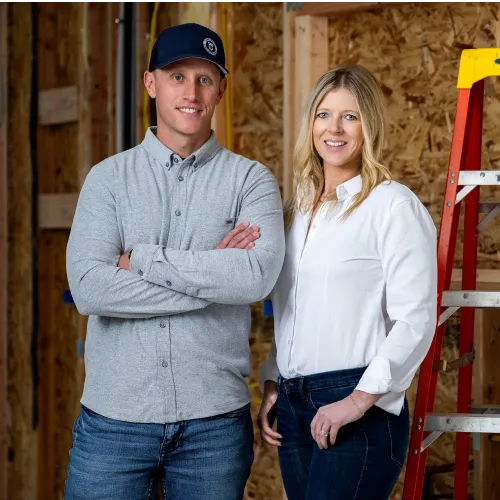
Steve and Heather Tankersley | Tankersley Construction
Places You Can find us




We think you’d also like this
podcast
Apr 4, 2024Adjusting focus: How cost-plus builders benefit from updated workflows
Listen to the full episode to hear more about the updated workflows that will better support the needs of builders using cost-plus contracts.

8 tips to ensure a superior client experience
Looking to make a lasting impression with your construction customer service? Here’s what to keep in mind when creating high-quality client services.
podcast
Mar 30, 2023Fund your future: Financing options to scale your construction business
Tune in to the full episode to hear about lending options for both your business and your clients and why taking advantage of loans can actually be beneficial.