
WIP reporting for builders: What you need to get right before busy season
Busy season doesn’t create financial problems, but it does expose them. When job volume increases, small inaccuracies in cost tracking, billing and forecasting multiply fast.
Builders who move from one or two active jobs to five or more often realize they don’t have clear, up-to-date insight into true job performance. Even when the bank balance looks fine and revenue appears strong, no one can answer the most important question: Are we actually making money on these jobs right now?
Without accurate Work in Progress reports for builders, busy season becomes risky instead of profitable. You can’t scale confidently if you don’t know where your margins stand today. That’s why Work in Progress reporting needs to be dialed in before production ramps up.
First, let’s clarify how a Work in Progress report works in your business.
What a construction WIP report actually does
A construction Work in Progress report is a financial snapshot of your active jobs based on work completed, not just cash in and cash out. It connects job costs, earned revenue and billing status into one clear view.
Instead of relying on cash movement alone, a WIP report shows what has truly been earned according to percent complete. That visibility is what allows builders to make decisions based on actual job performance instead of assumptions.
A proper WIP report helps you:
- Track costs to date against total budget
- Calculate percent complete based on actual job progress
- Recognize earned revenue accurately
- Identify overbilling and underbilling
- Project profitability across all active jobs
In simple terms, it’s the financial dashboard for jobs in progress. When updated consistently, it gives leadership an accurate picture of job health before issues compound.
Most WIP problems are not complex. They are process gaps that grow under pressure.

Get the data and insights on how top builders win in 2026 – and beyond.
What builders commonly get wrong with WIP reporting
WIP reporting for builders often breaks down when systems are disconnected. Field teams track progress one way. Accounting tracks costs another. Leadership sees a third version in a high-level report.
As the busy season approaches, these small disconnects turn into real financial risk. Here are the most common breakdowns builders face:
- Accurate tracking of overbilling or underbilling: Builders often don’t realize they’re underbilling until cash flow gets tight, or they bill too much too early and create margin pressure later. Without a WIP report, billing timing drives the numbers instead of actual job progress.
- Incorrect revenue recognition: When revenue is recorded based on invoices instead of percent complete, financial statements stop reflecting reality. Leadership makes hiring, purchasing and growth decisions on outdated numbers.
- Weak cost-to-complete forecasting: If cost updates lag or change orders are not captured quickly, projected profit looks better than it should. Surprises show up late in the job when there is little room to correct them.
- Disconnect between project managers and accounting: When project managers and finance teams are not working from the same data, meetings turn into debates about whose numbers are right. Without a single source of truth, alignment breaks down.
When WIP reporting lives inside your core job management system, you eliminate manual reconciliation and reduce surprises before they impact margin. Buildertrend addresses these gaps by connecting scheduling, budgeting, job costing and billing inside one system.
Buildertrend’s financial reporting tools allow builders to view job performance in real time, not weeks later. The solution isn’t more spreadsheets. It’s integrated financial visibility.
The solution: Buildertrend’s Work in Progress Report
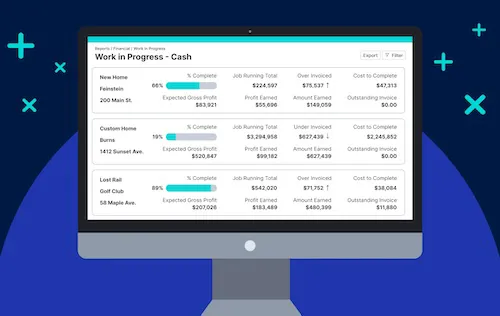
Buildertrend’s Work in Progress Report is designed specifically for builders who need consistent performance tracking across multiple jobs. It pulls job cost data, billing and budget performance into one easy-to-read view.
Here’s what Buildertrend’s WIP reporting delivers:
- Financial visibility across all active jobs based on work completed
- Percent complete calculations using real job data
- Identification of overbilling and underbilling
- Projected profitability updated as jobs progress
- The ability to compare jobs side-by-side to see which need attention
Because Buildertrend connects field activity with accounting, leadership can quickly see where profit is strong, where risk is building and where adjustments are needed. Instead of reacting at month end, you can make decisions while the job is still in motion.
With reporting foundations in place, the busy season becomes an opportunity instead of a gamble. This is why implementation timing matters.
Four WIP reporting foundations builders need before busy season
Busy season increases everything at once, bringing more subcontractors, invoices, billing cycles and decisions that directly affect your margins.If your cost codes are inconsistent or your billing process is informal, scaling amplifies the chaos.
Before peak volume hits, builders should have four core financial foundations firmly in place. When these systems are aligned early, growth feels structured instead of reactive. Those four essentials are:
- Matching cost codes across estimating, job costing and billing
Every dollar should flow through the same structure from estimate to final invoice. When cost codes are inconsistent, reporting breaks down and teams waste time reconciling numbers instead of managing performance. Clean, standardized cost codes ensure that what you estimated is what you track and what you bill. - Standardized billing processes aligned with percent complete
Billing should reflect actual job progress, not guesswork or timing convenience. When percent complete drives billing, revenue recognition stays accurate and cash flow stays steady. A defined billing rhythm also reduces friction with clients and keeps accounting predictable during high volume periods. - Consistent, up-to-date job performance tracking inside one system
Project managers and accounting need to work from the same data source. When schedules, budgets and costs live together, leadership sees the same numbers the field sees. That alignment reduces internal debate and speeds up decision making when workloads increase. - Reliable tracking of projected profit across all active jobs
Profit shouldn’t be calculated at the end of the job. Builders need to see projected margin as work progresses so they can adjust purchasing, labor or scope. Ongoing profit forecasting allows leadership to protect margin instead of reacting after it slips.
When these elements are in place, builders enter peak production with better control over every decision.
WIP reporting for builders: Scale with confidence this busy season
Established builders manage margins intentionally. They don’t rely on instinct or outdated spreadsheets to understand job performance.
WIP reporting for builders gives you the financial control needed to grow without guesswork. With Buildertrend’s integrated reporting, you gain real-time financial visibility, accurate revenue tracking and early margin protection before busy season peaks.
Don’t enter peak production without full financial visibility.
Schedule a demo today to see Buildertrend’s WIP report in action.
Based on what you just read, we think you'd enjoy...
These suggestions are made by our team to help you find builders and stories that you relate to!
Back to all blogs