
Markup vs. overhead: How to price your projects for profitability
Running a successful construction company takes more than great craftsmanship – it takes strong financial foundations. One of the most important concepts every builder must understand? The difference between markup and overhead – and how they work together to determine your true profit.
Buildertrend has partnered with Builder’s GoTo to help construction professionals understand how to price smarter, manage costs better and protect their bottom line.
Builder’s GoTo is a consulting partner that helps residential construction business owners understand their numbers, streamline operations and increase profitability through expert guidance on financial systems and estimating.
In this post, we’ll break down the difference between markup and overhead, why it matters for your business and how to calculate both to ensure profitability.
What’s the difference between markup and overhead?
Let’s start with definitions:
- Overhead: The fixed costs of running your business – expenses not tied to a specific project. This includes things like rent, office salaries, liability insurance, utilities, marketing and software.
- Markup: A percentage added to your project’s direct costs (labor, materials, subcontractors) to determine your selling price.
- Margin: The percentage of your selling price you keep after paying your project’s costs.
A common mistake builders make is assuming that markup equals profit. But that’s not the case.
Understanding this relationship is key to pricing your projects correctly. If your markup isn’t high enough to cover both overhead and desired profit, you’re undercharging – and that’s a fast track to financial stress.
Why it matters: The cost of getting it wrong
Let’s say you’re marking up all your jobs by 20% without ever reviewing your overhead costs. If your overhead is actually 18%, which leaves just 2% for profit – before taxes, errors, change orders or delays eat into it.
You’ve done all that work for virtually nothing.
Research shows many small business owners underestimate overhead. According to NAHB, general overhead for home builders can range from 10% to 25%, depending on business size and structure. If you’re using a flat markup that doesn’t account for your unique overhead rate, your pricing could be dangerously low.
How to calculate your overhead percentage
Your overhead percentage is a measure of your company’s fixed costs compared to your project’s direct costs if using markup or your income if you use margin.
- Run a profit and loss report for a recent period (quarterly is a good benchmark).
- Total your overhead expenses and remember, these are costs not tied to a specific job (admin salaries, rent, insurance, software, etc.).
- Divide that overhead total by your direct costs if using markup, and your income if using margin.
For example, if your total income over the quarter is $750,000, direct costs are $500,000, and your overhead expenses are $75,000, your overhead percentage would be calculated as follows:
Using markup: $75,000 ÷ $500,000 (COGS) = 15% overhead
Using margin: $75,000 ÷ $750,000 (Income) = 10% overhead
Pro tip: Revisit your overhead percentage at least quarterly. As your business grows or changes, so do your costs.
How to calculate a profitable markup
Once you know your overhead percentage, you can calculate a markup that covers both overhead and your desired profit.
Here’s a simplified version of the formula:
Markup % = Overhead % + Profit %
So, if your overhead is 15%, and you want to make a 10% profit, your minimum markup should be 25%.
But remember, markup isn’t added on top of the final price – it’s applied to your costs. To get it right, you may need to gross up your costs to ensure your pricing supports your financial goals.
Quick formula:
Selling Price = Cost ÷ (1 – Overhead % – Profit %)
For example:
You have a job that will cost $100,000 in labor and materials. Your overhead is 15% and your desired profit is 10%.
Selling Price = $100,000 ÷ (1 – 0.15 – 0.10)
Selling Price = $100,000 ÷ 0.75
Selling Price = $133,333
So, your true markup should be 33.3%, not just 25%.
Pricing isn’t static – neither is your markup
It’s important to understand that markup isn’t one-size-fits-all. Your markup should flex depending on:
- Project complexity
- Client risk
- Schedule volatility
- Your current overhead rate
This is where software like Buildertrend becomes a crucial tool.
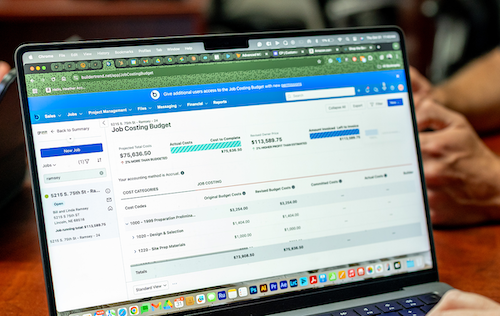
“The Job Costing Budget lets you track each cost line against what you estimated,” Carla said. “It gives you time to course-correct before things spiral.”
Job costing reports and dashboards can help you:
- Stay on top of overhead trends
- Adjust markup per project type
- Monitor profit margins in real time
Specialized software is replacing spreadsheets, as builders recognize the efficiency and error reduction it provides. According to the Association of Professional Builders’ 2025 State of the Residential Construction Industry report, a documented sales process contributes significantly to the profitability of new home builders, with builders achieving a median gross markup of 25% compared to 20% for those without.

2026 State of Residential Construction Industry Report
Get the data and insights you need to grow your building company.
Price is for profit, not guesswork
Buildertrend’s partnership with Builder’s GoTo is all about empowering builders with the financial insight they need to succeed. Knowing the difference between markup and overhead – and how to calculate each – is the foundation of profitable pricing.
But with financial coaching like Builder’s GoTo, you get more than just numbers – you get strategy. Get in touch with Carla to learn more about her services and get started on the path to financial success today.
Now’s the time to take control. Don’t leave your income – or your business – up to chance.

Based on what you just read, we think you'd enjoy...
These suggestions are made by our team to help you find builders and stories that you relate to!
Back to all blogs