



High stakes, higher rewards: Using innovation to turn challenges into triumphs
This episode was recorded in 2025. Because Buildertrend continues to improve and expand its platform, some features or services mentioned may have changed.
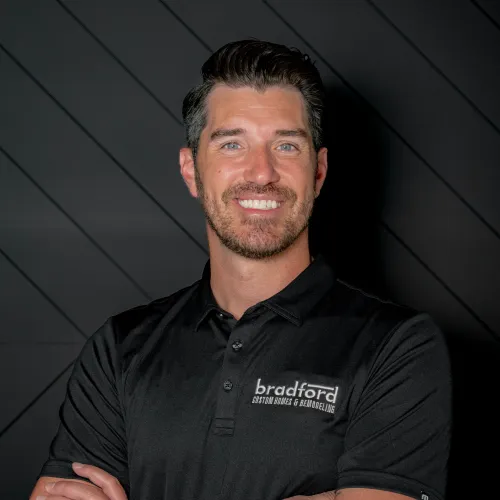
On this episode of “The Building Code,” Charley is flying solo with returning guest, Brad Robinson, president at Bradford Custom Homes. Brad is a seasoned entrepreneur and problem solver, bringing years of experience from high-end residential and commercial construction. He’s the driving force behind the company’s strategic vision, ensuring every project reflects the highest standard of excellence.
Tune in to the full episode for a sneak peek of Brad’s panel at the International Builders’ Show exploring how innovative project management techniques can transform intricate construction projects into seamless achievements.
How do you manage the complexity of the homes you build and how do you make sure your team is executing at a high level?
“I think it goes to our core philosophy that planning is the single most important phase of a construction project. And if you fail to plan, you plan to fail. So, it starts by having a process in the pre-construction phase that can complement the construction phase. It’s not the other way around. The project management downstream is intended to execute what you’ve built ahead of time. We’re focused on creating the best possible client experience. The philosophy of our businesses is that we want to ease pricing concerns. We want to ease what the scope of work is going to be. We’re very thorough, we’re very transparent. The process that we’ve created in the pre-construction phase allows for that. It allows for our customers to go into the construction phase with no questions asked and feel like we’re going to be able to execute exactly as their vision was originally depicted to us.”
What kinds of tips for success do you have for someone coming out to the Builders’ Show for the first time?
“Man, don’t come out here and fly by the seat of your pants. Jot down the top three things you want to do in the day and force yourself to go do it because it’s so easy to get distracted. You’ll miss out on things. And the feeling of coming back home and having regret that you didn’t go do those things, it sucks, because I’ve been there. And then the other thing I would say is, if you’ve been following somebody on social, you’ve been watching somebody from afar, you admire what they’re doing, you might hate me for saying this but say ‘Hi.’ That might mean a lot to somebody, and it might open a door to a conversation where you now have a new connection. And I feel like those connections have been very powerful for me.”
Links and more
Learn more about Bradford Custom Homes.
Attend Brad’s panel at the Builders’ Show.
Attend the 2025 International Builders’ Show in Las Vegas coming up at the end of February.
Get your free IBS expo pass on us and start planning your trip.
If you haven’t already, now’s the time to set goals for your construction business. Download this free construction strategy template created by the team at Breakthrough Academy and get:
- Simple directives to get you started
- A complete example for reference
- An editable template to start using immediately
Related content:
Listen to the last episode to hear from Gene Marks, founder of The Marks Group, as he shares strategies for managing overhead costs and securing financing to ensure operational stability and growth.
Subscribe here and never miss an episode.
Got podcast topic suggestions? Reach out to us at podcast@buildertrend.com.
The Better Way, a podcast by Buildertrend:
Looking to add construction tech to your daily processes? On the newest season of “The Better Way, a podcast by Buildertrend,” you’ll get best practices for implementing software and getting your team on board from other industry pros and our experts. Subscribe and stream today wherever you listen to podcasts.
Follow us on social:
Listen to “The Building Code” on YouTube! And be sure to head over to Facebook to join The Building Code Crew fan page for discussions with fellow listeners.
Charley Burtwistle (00:05):
What is up everybody? Welcome back to another episode of “The Building Code.” I’m your cohost, Charley Burtwistle. And I’m Courtney Mattern. Just kidding. Courtney Mattern is not here today. It is just me. Courtney is home sick, so if you’re listening to this, two weeks from now, Courtney, I hope you feel better by then at the very least.
(00:24):
But when it comes to episodes that I have to do solo, I could not have picked an easier one to do today. We have Brad Robinson, President at Bradford Custom Homes. He is fantastic. He’s been on before, episode 199 if you want to go back and listen to that. I have kind of recently over the past few months became pretty close personal friends with him. He is in the infamous 75 hard workout group chat that I’m in with some celebrities such as Mark Williams and Mike Weaver and the Tankersleys.
(00:54):
So, super excited to talk to Brad today. He is going to be at the International Builder Show hosting a panel about project management, “High Stakes, Higher Rewards, How Smart Project Management Turns Complex Builds into Success Stories.” So, if you’re going out to the Builder Show in Vegas, definitely mark that on your calendar. Make sure to go and listen to it. If you are not going to the Builder Show, then you’ll get at least a sneak peek in this episode over the next half an hour with my good friend Brad. So, I’ll stop rambling. I’m not as good at banter without someone to banter off of. I miss you, Courtney. So, let’s cut to the chase and get Brad in here. Hey Brad, welcome back to “The Building Code.” You were here back on episode 199. How’s it been going since then?
Brad Robinson (01:38):
Man, it’s always good to be in good company.
Charley Burtwistle (01:41):
Love that.
Brad Robinson (01:41):
Doing great, man.
Charley Burtwistle (01:43):
Love that. Love the attitude. I was fired up for today. We actually had to reschedule this, so got teased a little bit on Monday when I thought you were going to be on. We had something come up, had to move it to today, but I’ve had this one circled on my calendar for a long time. For listeners that didn’t catch your last episode though, I always like to start off by just telling a little bit about yourself, kind of how you ended up in construction and how you got to where you’re at today.
Brad Robinson (02:05):
Yeah, man. So, I’m Brad Robinsonwith Bradford Custom Homes down in Atlanta, Georgia. I’ve been in construction what feels like my whole life. I got into this after really, high school … Well, high school, college, but I was in a business management program, not in a construction management program. So, knew I always wanted to be in business for myself. My family had a business semi-construction related. They were in the grading and hauling business or land development business. And so, I knew that entrepreneurship was going to be the way for me to go.
(02:42):
So, I got into the business though through the trades, and I owned a turnkey painting and drywall company that serviced other local custom home builders. And I had an opportunity to really kind of peek behind the curtain on high-end luxury home building from a very early age. So, I kind of consider myself lucky to have been able to go through that.
(03:05):
Grew that business to by 2014, I think we were somewhere close to $13 million. So, we were pumping. It was great. Even after the recession we were able to do okay, but as I dipped my toe into the commercial space, I really just took a liking to the design aspect of things, and I had to go chase it. So, I spent some time in corporate world selling products back to retailers and then selling design to retailers, and that was really kind of a cool place to be for a while.
(03:40):
Actually, it was part of RDI, which is the Retail Design Institute, sat on the board there and then 2018 came around and business was booming, and my phone was ringing. I was like, “Man, I’ve got to jump back into this.” And it just so happened that I got started doing some pretty decent high-end remodels until we started rip-roaring into new construction and then our new construction went from building pretty practical houses and then really just took off as the clients had more resources and wanted us to do better things. And then all of a sudden, fast-forward to today, I feel like we’re one of the leaders in our market from a luxury design build perspective. I feel like we’ve got an amazing team. I think we’re up to 18 employees these days, and we just built process, built team, and it’s been a blast.
Charley Burtwistle (04:36):
I was doing some research before this on your website, and if anyone wants some motivation into really cool custom unique like awe-inspiring designed homes, they should scroll around on your dot com because the pictures that you guys have up on there, I don’t even know how to describe it. It looks like a set from a reality TV show almost. You’re just constantly pushing boundaries, like you said, later in the market. And super excited to have you on to talk today.
(05:03):
Kind of goal for today, you’re going to be speaking at the International Builders’ Show, which when this drops will only be about two weeks out. So, I’m sure people are scrambling to figure out their agenda, what they’re going to do out in Vegas. Title of your panel will be “High Stakes, Higher Rewards, How Smart Project Management Turns Complex Builds into Success Stories.”
(05:21):
So, as I alluded to, you guys are constantly pushing boundaries, building really, really cool stuff, and I’m sure you’re only able to do that because you have a really, really dialed project management system and processes and SOPs in place and all the good buzzwords. So, that’s what we want to talk to you a little bit about today. I’d love to start maybe just jumping straight in. If you could talk about how you manage the complexity of the homes you build and how you personally stay on top of it and how you make sure that your team is executing at a high level.
Brad Robinson (05:54):
Yeah, I think it goes to our core philosophy that planning is the single most important phase of a construction project. And if you fail to plan, you plan to fail. So, it starts by having a process in the pre-construction phase that can complement the construction phase. It’s not the other way around. It’s like yes, the project management downstream is intended to execute what you’ve built ahead of time. We are focused on creating the best possible client experience. And so, the thought or again, the philosophy of our businesses is that we want to ease pricing concerns. We want to ease what the scope of work is going to be. We’re very thorough, we’re very transparent. The process that we’ve created in the pre-construction phase allows for that. It allows for our customers to go into the construction phase with no questions asked and feel like we’re going to be able to execute exactly as their vision was originally depicted to us or given to us.
(07:07):
But as you do get downstream, if you look at the way that we’ve structured our data from the way that that data is transferred from the pre-construction team to the construction team, we’re leveraging all the tools, we’re leveraging the folder structure, we’re leveraging the to-dos, we’re leveraging the schedule in a significant kind of way, and we have a process that doesn’t allow for people to get too far out front of their skis.
(07:34):
Most of the time, my take on it is that project managers are deputized to execute the project any way they say fit for the most part. Now, barring that, the company may have some processes or some procedures that are meant to check quality or you have a checklist at this phase of this part of the project, all that good stuff, very important. But it starts before you even get to a checklist or a checkpoint in the project or at a milestone.
(08:06):
It starts with, what’s your process to hand the baton? Have you really figured that out yet? We have a 50 to-do checklist that goes from administration all the way down to the guy that’s the runner. Everybody’s got a part to play in how that project gets kicked off. And if you start well, usually, and you have process built in, you’re going to end well. But the idea is to start with the end in mind.
(08:36):
It’s like no better guy to say it, Simon Sinek, you have to know where you’re going, so you can plan well, prepare, and get to the place you want to be. I’m not looking for the client experience. I’m not looking for my clients to say, “Oh, this was an okay process. It was okay.” I’m not satisfied with, okay. I get it but okay doesn’t get me five-star reviews. Okay doesn’t mean that you’re going to tell your friend about your experience the next time you’re together at a dinner party. Okay is just not good enough in my organization.
(09:13):
So, how do I predictably create an experience? How do I predictably create a process that can be repeatable multiple times? It’s just everything is documented, and every single thing is prioritized in the way that I want it to be. And no matter if it’s a customer that’s experiencing us in Atlanta or a customer that’s experiencing us in Charleston, they’re going to have the same experience. And that’s what I’m looking for.
Charley Burtwistle (09:45):
That’s such a fantastic perspective. I think a lot of times people get lost in as long as the final product is good or even go as far as say as long as the final product is great, that’s my brand. That was what people will talk about. That’s what I can display on my dot com. But the final product is not when it’s going to get you the recommendations and the network and the reviews that you need and the experience. It’s the entire process of building the home is either going to be the worst experience that someone ever went through or the best or the worst. And that’s what’s going to ultimately lead to the reviews, and them telling their friend about it, and everyone wanting to go through Bradford Homes because the experience was great and the end product was obviously great.
(10:32):
But your perspective about preparing on the front end and the pre-construction phase is something that we constantly preach at Buildertrend is template everything out. Have SOPs template everything out. You do it inside of Buildertrend and pushback that we often hear from custom home builders is, “Well, I’m a custom home builder, so every project is completely different.” So, how do you toe the line between having your consistent processes that you’re going to need to hit? You mentioned the 50-item checklist or whatever with every home that you build is different and there are going to be different requirements and different timelines throughout each one. How do you marry those two together?
Brad Robinson (11:10):
There are nuances in every business. It doesn’t matter if we’re building homes or if we’re building widgets in a factory, right? Each widget is going to require its own SLA or SOP to get it to the place where it’s boxed up and shipped out. I look at building a house the same way. It’s like I can give you one example that we talk about in our new project set up or a new project. That’s what we call it internally. But really when a new project’s getting fired up and the PM is beginning to work through that, one of the things is we do remodels.
(11:41):
And so, one of the challenges that we face, and one of the things that I try to avoid as much as possible is I want that staging area. I want that concrete washout in the exact locations that we plan for it. I want down to where the porta potty is going to go. There needs to be a plan for why it was placed there. And for instance, on a new construction job, we may not flag a driveway. We have a construction entrance, but on a remodel, we have a process where we flag the driveway, so that no one will drive on the corners of the driveway or drive into the sod, right? Because that sod costs me money. That concrete costs me money if we crack it or chip it. So, in a remodel environment, it’s a CYA in some cases, and it’s a cost preventative measure to save money proactively. But I have to distinguish between the two when I’m doing a new project setup. So, we have it written in as simply put, it’s in parentheses, “If a remodel, do this,” you just have to have a place for it.
(12:47):
And I think what it helps do is that oftentimes when you talk about what the differentiating factors of what a good builder is, does your builder have the foresight from the experience of going through it? I can place a relatively inexperienced project manager into my system and still expect a high degree of success because of the process I have in place. So, there’s benefits that yield that are far beyond just the customer side of the experience, but from a business perspective, I’m fighting for every dollar that I make in here. I have to preserve those dollars. I think, I forget who said it, but as a builder, it’s not my responsibility to hit the budget. It’s my job to preserve the margin that I projected that I was going to make.
Charley Burtwistle (13:43):
Yeah, I love that thought process there. And you touched on this a little bit, but you can plan for the customizability. Every project is going to be different, but you can plan for that and have these different if or statements throughout your standard SOPs. But what I’m really finding just early on, we’re like what 10 minutes into this interview is that post the handoff, it’s all about execution and there shouldn’t need to be that much decision-making outside of executing the plan that’s already been in place.
(14:16):
I’m sure you have another fantastic philosophy here just based on how you execute. What is the kind of philosophy around your communication style of when you have questions or when something gets off track, how do you communicate across your team, maybe between the initial plan if they have questions from the initial plan that you put in place to the actual implementation of that plan? What’s kind of the communication style across your team?
Brad Robinson (14:40):
Well, typically if there’s going to be a deviation in what was planned versus what we’re actually doing, I mean we’re going to know about it pretty early on, but the outlet for that naturally is our production meeting. So, I mean, we do rally around the table still. We do it once a week, and that’s typically enough. I mean, a lot of these projects are 12 to 18 to 24 month cycles. So, everything is important and everything is prioritized appropriately. But that one thing that we’re talking about may not be the topic that needs to stop the day.
(15:16):
So, what we try to do is keep the communication flow open, but I mean there’s levels to it as well. I mean, our director of operations can answer that question. Our pre-construction manager can gather that information. But typically, the builder or the project manager who’s responsible for executing at this point is going to reference back to the document file structure, go back and review the details, look at the schematics, try to determine if there was something that was missed. There was an error in a mission from an estimator’s perspective, or the scope wasn’t developed or there was a miss in the scope, they’re going to check those documents.
(15:50):
But all those documents, everyone in our organization knows exactly where to go back because they’re centralized. So, having that centralized data point is really the most important factor, which again, when pre-con is coming out, we don’t pass those files over prematurely. So, in project files set up, we actually transfer the files together. So, they’re moving from pre-construction, our pre-con files, and now that Buildertrend has the capacity to manage pre-sales, we move everything from that or the drive, which we’re moving off of the drive officially now that we’re in pre-sale mode with Buildertrend.
(16:28):
So, all those projects that are in pre-construction agreements because all of our contracts are written in two. So, you have a pre-con agreement and then you have your construction contract. We actually can move those documents from one to the next. We do it together to ensure that those are the stamped, whether those are the documents that are the official documents of the record, so that only the most up-to-date documents stay in that folder. So, when we hand that off, we validate at the same time.
Charley Burtwistle (16:56):
I love that. You kind of stole my thunder earlier with your comparison about it doesn’t matter if you’re building a home or widgets in a factory. That’s what I always love to say. And my favorite part about being a podcast host here is I constantly get nuggets of information from the customers that we’re talking to in the home building space to how I can implement here at a tech company at Buildertrend. Literally what we’re building out right now, where I was at right before we came into the studio today was talking through just our project management function and how we standardize as much as possible. So, when we have idea creation from the executive team all the way to implementing the boots on the ground across the floor, it follows the consistent structure. And one of the main things I’m focusing on right now is a kind of centralized documentation, centralized and consistent documentation structure.
(17:41):
So, when people have questions, they go to the same place every single time and it looks exactly the same regardless of what the project is or how far along it is or how big it is. So, I am taking notes as you’re talking that I’m going to steal and go back to work and implement here at Buildertrend as well too. Another thing that you hit on there that I thought was really insightful is it sounds like you have pretty clear kind of roles and expectations or roles and responsibilities across each of your given roles in your company?
Brad Robinson (18:12):
Yeah, very structured. So, each employee that we hire, typically it’s a traditional role in the construction industry. These are common roles in other organizations, but we do have a couple outliers where it’s a little ambiguous and we’ve crafted some titles, but we have a philosophy around here that your title doesn’t matter, so don’t take it to the head.
(18:37):
But every employee that we bring in, whether it’s the first time or if I update it, you get two things when you come to work here. You get your employee agreement, obviously, but you get a mission, and that role mission is going to take you a lot deeper into what it is that you’ll be doing for us. And then I oftentimes at the bottom of the mission will suggest relevant podcasts or relevant books or relevant reading points that I feel like that person in that role might best benefit from.
(19:15):
And then I give them usually a couple of quotes that I like that are really kind of fit for what they’re going to be doing for us. And then when we bring them through their onboarding, we kind of bring all that to light. It all bubbles back up. They’re like, “I recall in the mission, that’s exactly what you said.” And we kind of put it together for them as they onboard. It’s like we don’t have a philosophy around here that when you join, you just, “Here’s your desk, here’s your equipment, sink or swim.” We don’t do that here. And I know there’s a lot of organizations that don’t have the option. This at the end of the day is the busiest job I think one can have, but we are a little bit bigger now and have people in between. We’ve got a management full stack in here now.
(20:07):
So, it’s like, “Okay, you know who you’re reporting to and they’re your support mechanism” and, “Okay, here’s your buddy.” I took this from a company that I worked with. It’s like, “Hey, if you have questions that are really company related or driven or cultural related or driven” and like, “Hey, what’s the standard policy around this?” If you really just kind of forgot or need to touch somebody, it’s like, “Here’s your buddy, call your buddy.” Everybody’s got somebody to kind of lean on. And so, we don’t have that formalized, formalized, but everybody kind of knows it, and it works.
Charley Burtwistle (20:42):
Yeah, I mean really what I just continue to hear from you is kind of how you started this with failing to plan is planning to fail. And it sounds like it starts all the way at the initial hire stage for you and your company all the way through the pre-construction phase and just being really, really intentional about every single detail and then the rest, just go out and do your job from there, which I think is awesome.
(21:06):
The way you explain it makes it seem so simple, but obviously, something that everyone is constantly struggling with and trying to get better at. I want to make sure we don’t give away all your secrets before your panel at IBS, but this is fantastic. But speaking of IBS, what are you kind of most looking forward to about getting out to Vegas this year?
Brad Robinson (21:25):
Oh man, I can’t put that into one sentence for sure. I think I feel incredibly blessed to have the opportunity this year not only to come and participate and take away all the things that I would naturally love to come to the show to do. The networking, spending time with friends that I talk to around the country, going to spend some time with you. I mean, I know we talk pretty much every single morning at this point, but it’s like I’m excited to be around those people and for a little bit of fellowship, but beyond that, the opportunity to contribute to the conversation has been really important for me. And this year it kind of comes to fruition being able to communicate some of these things that are important, and I can actually contribute and give back in any way that I can.
(22:15):
So, it’s like if I can give one nugget to somebody that’s listening, and it brings value to their company, I would think it’d be a success. And I get to do that, not once, but I get to do it twice. And I get to see the one and only Mike Weaver on Tuesday because we’re talking about the value of partnerships. But that’s going to be fun, too, and you know that means a lot to me. But I think maybe we’re going to play some basketball. I know my boys at Cambria are looking for a rematch, so that’ll be some fun. Maybe get some workouts in with you while we’re there and see if Bradley Levitt will let me arm wrestle him for some time on the course. So, stingy with it. He only plays with his friends.
Charley Burtwistle (22:58):
Yeah, I mean that’s a jam-packed schedule right there. Maybe the ideal IBS schedule that anyone could possibly come up with. Subtle promo as well, too. We will be having daily happy hours at the Buildertrend booth, which I’m sure you’ll be around for, but that’s always the biggest part that I get out from IBS is kind of the organic conversations. Like, sure, it’s great to go to the talk. Sure, it’s great to go check out all the vendors, what’s new in the space and everything. But going and having a beer or a soda with someone at the end of the day and just talking about, “What’d you learn today? What are you looking to do this next year?”
(23:31):
Those organic conversations that you pick one or two nuggets out that it’s hard to ask really, really intentional questions because a lot of times you don’t know what the problems that you’re trying to solve, but it’s really, really easy to listen and talk and always go away with one or two nuggets. So, if you’re around the show, spring by the Buildertrend booth, have a beer, hang out with us, have those kinds of organic conversations and take it from there. But yes, I’m very much looking forward to some workouts. And if you need a sixth man for basketball, let me know as well, too.
Brad Robinson (24:02):
I know it’ll be fun. It’s going to be so tight, but I think we got to try.
Charley Burtwistle (24:07):
You have to, right? What else are we going to do? Go gamble our money away?
Brad Robinson (24:12):
I gamble enough here.
Charley Burtwistle (24:16):
What kinds of tips for success would you have if someone’s coming out to the Builder Show for the first time? How do they make the most out of their time?
Brad Robinson (24:23):
Man, don’t come out here and fly by the seat of your pants. Jot it down.
Charley Burtwistle (24:23):
Plan.
Brad Robinson (24:28):
Jot down the top three things you want to do in the day and force yourself to go do it because it’s so easy to get distracted. You will miss out on things. And the feeling of coming back home and having regret that you didn’t go do those things, it sucks because I’ve been there, and I know exactly what that is.
(24:49):
And then the other thing I would say, a tip for success is if you’ve been following somebody on social, you’ve been watching somebody from afar, you admire what they’re doing and you see them while you’re there, and people might hate me for saying this, but say “Hi.” Talk to them, bridge the weirdness. They’re just people, man. If you’ve got fans out there, just talk to them. I feel like there’s been so many great connections made because it’s just like, “Hey man, look, I really respect what you’re doing. It’s really cool to see. It’s impressive. Thanks for giving me a little bit of motivation.” That might mean a lot to somebody, and it might open a door to a conversation where you now have a new connection. And I feel like those connections have been very powerful for me.
Charley Burtwistle (25:40):
Yeah, absolutely. I mean, have maybe one, maybe two people come up to me yearly and recognize me from the podcast. So, pretty big celebrity status over here, but it’s the greatest compliment that I get the entire year of someone saying, “Hey, listening to the podcast, I love what you do.” I’m like, “Oh, thank you. I guess I won’t tell Courtney I quit, and I’ll keep doing this for a while.” I like that. It fills the bucket. And I feel like that’s a pretty wide kind of maintained opinion as well, too.
(26:09):
And the other thing that I’d say you kind hit on this a little bit is like you’re drinking from a fire hose when you’re there. Plan, make time to do the things that you for sure want to do. Spend some time or slot out some, designate some time to roam around and explore a little bit as well, too.
(26:23):
But what I’ve done in the past that’s really worked well for me is that the end of every day, write down your one thing. What is the one thing I’m actually going to go back home and implement? What’s the one thing I think I can actually change in my business? What’s one thing I want to try or research more? You could have pages and pages of pages and notes, but if you take pages and pages of pages and notes home, you’re not going to do anything. So, pick out the one thing that you’re going to do and be really intentional about it.
Brad Robinson (26:47):
Yeah, man, the show is humbling. There are people there from literally all over the world that have very different experiences than you have, and all you have to do is open the two ears between your brain and you can take something away that might change your business for the rest of your time in business. As long as you come there open-minded, I feel like that’s the people that get the most out of it.
Charley Burtwistle (27:14):
Absolutely. And then the last thing I’ll say kind of on the IBS note is if you’re not coming out this year, well that means one, you have 12 months to book your ticket for next year. But also, the same principles that Brad was just talking to applies across any landscape that you’re in. Like reach out to someone via LinkedIn, slide into someone’s Instagram’s DMs, like introduce yourself, like the construction space and the home building remodeling community is just so opening and people love to share and be vulnerable. Start that connection and you never know where it might lead.
Brad Robinson (27:47):
Absolutely, man. Couldn’t say it better.
Charley Burtwistle (27:51):
Well, Brad, we’re about at time here. Thank you so much for coming on today. I’m fired up to go implement some SOPs here at Buildertrend. I’m fired up to see you out at Vegas, fired up to send you a workout pic tomorrow morning. Thank you again so much for coming on. Always appreciate having you, and we definitely need to start scheduling your third appearance here pretty soon.
Brad Robinson (28:11):
Anytime, man. Anytime.
Charley Burtwistle (28:13):
Thanks, Brad.
(28:15):
Well, we just heard from Brad Robinson, president at Bradford Custom Homes. This is typically when I would ask Courtney what she thought about the episode, but since she’s not here today, I guess the hard question lands on me. So, I’ll tell you guys what I thought of the episode. I thought it was a fantastic episode. The only thing that could have made that better was Courtney being here. I’m always inspired when I come on the podcast. I have the privilege to talk to some of the not just best home builders and remodelers in the country, world, actually, but also some of the best just business minds and people in the world. And Brad’s attention to detail, you can just hear it when he talks. Every single step, every single process is detailed out and is intentionally decided on throughout the entire course of their project.
(29:03):
From the pre-construction phase all the way through the construction phase. The way he described it was best is the only reason that you’d be missing something in that process is if you haven’t experienced it before. And so, learning from each project that you do, figuring out what went well, what could have improved, taking those learnings, rolling it into the next project. You may have messed up one time, but you can sure as sure as heck not going to mess up again and just planning for that for the very next time. Failing to plan is just planning to fail, just like Brad said. So, I thought that was inspiring. It’s definitely something that all of us can take away. I know me, personally, I’m going to take it away from my role here at Buildertrend. So, regardless of what construction industry that you exist in or what industry in general that you exist in, I thought a lot of what Brad said can be held true.
(29:55):
And if you’re willing to take those steps and have a growth mindset and constantly look to improve, then I think that the project management and the templates and SOPs across your business is a fantastic place to start. So, again, if you were as motivated by that episode as I was, then get out to Vegas this year and listen to his panel. He will be there, introduce yourself, mention that you heard him on “The Building Code.” Give me some clout there and it’ll just be a fantastic time for all. We’ll all learn a lot and it’ll be great.
(30:23):
So, I think that about does it for us. Like, review and subscribe. Leave a nice review about how you like episodes with Charley so much better than episodes with Courtney. Give her some FOMO. Join The Building Code Crew on Facebook, and always, I will see you next time. Peace.
Brad Robinson | Bradford Custom Homes
Places You Can find us




We think you’d also like this

8 tips for improving construction efficiency
Efficiency is the one thing impacting your ability to deliver high quality construction projects. Learn how to improve it!

Construction project planning explained
Improve your project planning for construction jobs to save time and increase your profits. Learn how Buildertrend can help.