Economic and industry news or trends
Land, labor, money and residential construction: An update on our 2023 economic outlook

Earlier this year, we published our 2023 Residential Construction Outlook. Hundreds of builders were surveyed, and we analyzed internal data along with industry benchmarks to highlight where the home building and remodeling market stands – as well as where it could be headed. A potential recession. Increasing inflation. Shortages in labor and supply.
All these challenges loom large over construction in 2023. Yet opportunity awaits for well-prepared builders who remain agile. Inside our report, we reveal strategies to pivot your business and stay ahead of whatever comes next. You don’t want to be the builder who just waits and sees.
Be sure to get your full copy of the report here.
However, even in an uncertain economy, one thing is guaranteed: The market is always changing. That’s why we asked Mathieu Dubeau, Ph.D., to share an update on where everything stands now that the first quarter of the year has come and gone. Mathieu is a user researcher here at Buildertrend – much of the reporting within our 2023 economic report was led by him.
Hear more firsthand from our in-house expert below:
What the Fed’s interest rate hike means for builders
Currently, 99% of all mortgages have an interest rate lower than the average set by financial institutions. Hourly construction wages grew at a rate of almost 6% during 2022. And while construction material prices have dropped and steadied since their steep increase during the pandemic, broader inflation remains stubbornly high.
In an attempt to lessen the impact of inflation, the cost of borrowing money has nearly quadrupled since the Federal Reserve began raising interest rates last spring. While higher interest rates haven’t had the immediate impact of reducing the cost of all goods or completely overwhelming the economy, they have generated significant economic headwinds and raised the cost of doing business.

Even with these large changes in the labor and financial landscapes, there is some good news for home builders: Home prices have remained relatively steady, and the housing supply remains low nationwide. This means opportunity for new business.
Higher interest rates have perhaps had counterintuitive effects that conflict with the Federal Reserve’s initial logic. The Fed believed higher interest rates would decrease housing demand, increase supply and reduce the cost of housing.
Your clients’ dilemma: Should they sell or renovate?
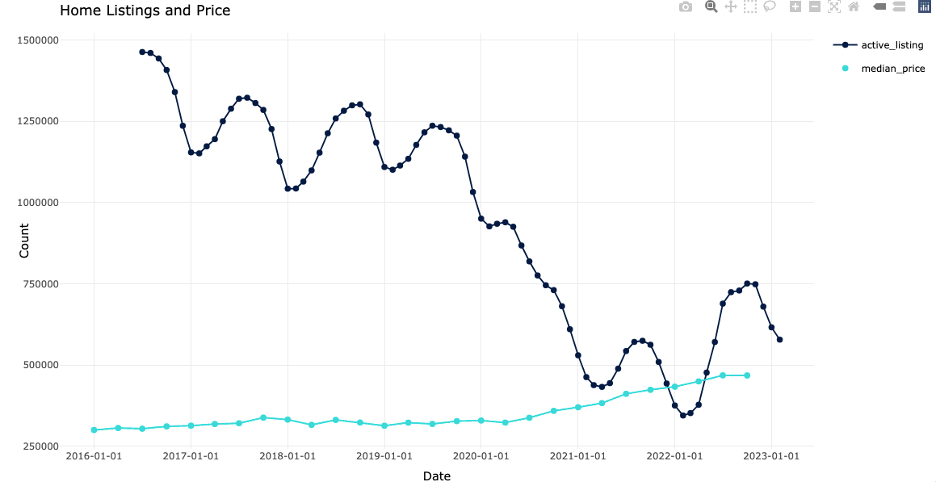
What we observed in the aftermath of the initial rate hike was an increase in listed properties with a rapid return to the low monthly listing environment. In fact, interest rates may be forcing homeowners to delay housing upgrades due to the exponential increases – call them golden handcuffs or the lock-in effect.
For homeowners, the incentive for keeping their existing homes is clear: Upgrading or moving at this time will incur a much higher price tag than it would have just eight or nine months ago. For new home buyers, because housing supply remains low, home prices are relatively stable.
However, the slight decline in home prices we’ve seen isn’t enough to match the cost increases of originating a mortgage under these financial conditions. What does this mean for new home buyers? They might consider delaying or updating their preferences to different types of housing when it comes to homeownership.
A growing nationwide housing shortage
What do these trends mean for builders, remodelers and specialty contractors working in residential construction? First, it’s important to know that interpreting, much less predicting, the ups and downs of the economy is incredibly difficult. However, we do know that while changes in the macroeconomic structure bring new risks, they also bring fresh growth opportunities.
This has never been truer for residential construction. What continues to be the case in residential construction, particularly in the United States, is the persistence of the nationwide housing shortage. At present, the United States is facing a 5.5 million-unit housing shortage that’s heavily felt in large metropolitan areas.
That deficit continues to grow.
Even with year-over-year increases in new single- and multi-family home construction, the current rate of new home construction is not capable of addressing the housing deficit. In fact, the National Association of Realtors argues that the United States would have to build 2.1 million more homes per year than it currently does – for the next decade – to effectively address the housing deficit.
These unique conditions come together to create a perfect storm. This storm has led to the current unaffordability crisis worsened by higher interest rates throughout the country.
What can builders expect – and do – next
It’s not all doom and gloom – there’s plenty of good news, too. The current market conditions work to largely protect the residential construction industry from economic volatility. Despite recent headwinds, permits and starts for single- and multi-family homes are beginning to rebound from their decline with rising interest rates.
There continues to be demand for residential housing, but we also observe changing needs and wants as homeowners are confronted with a higher-cost construction environment.
The graph below shows how single- and multi-family starts are beginning to converge. As the costs of labor increase, we anticipate quicker and wider adoption of multifamily housing – especially in large metropolitan areas.

Second, with the overwhelming percentage of homeowners locked into low-interest mortgages, we foresee a future increase in remodeling opportunities. Home values will not see the rapid growth they did during the pandemic. This means equity will be built more slowly, and the justification to upgrade through new housing will become less appealing. This may produce a market shift where more homeowners opt to update and renovate their existing homes.
Lastly, it is during these times, when macroeconomic markets (land, labor and money) are volatile, that accurate project and financial management paired with strong labor relationships can mean the difference between success or failure.
That’s where Buildertrend’s construction management platform comes in.
With digital tools for project planning, sales, financials and communication, this is the one system every builder needs to work simpler and smarter. Our products paired with your construction expertise create the competitive advantage you need to navigate today’s economic uncertainty. To see Buildertrend in action, schedule a demo today.
About Mathieu:
Mathieu Dubeau earned his Ph.D. in Political Science from the University of Washington, Seattle in 2021. At Buildertrend, he joins his passions for economics and research with the Buildertrend mission of empowering builders in the residential construction industry.

Based on what you just read, we think you'd enjoy...
These suggestions are made by our team to help you find builders and stories that you relate to!
Back to all blogs