- Guide for growing contractors
Guide for growing contractors
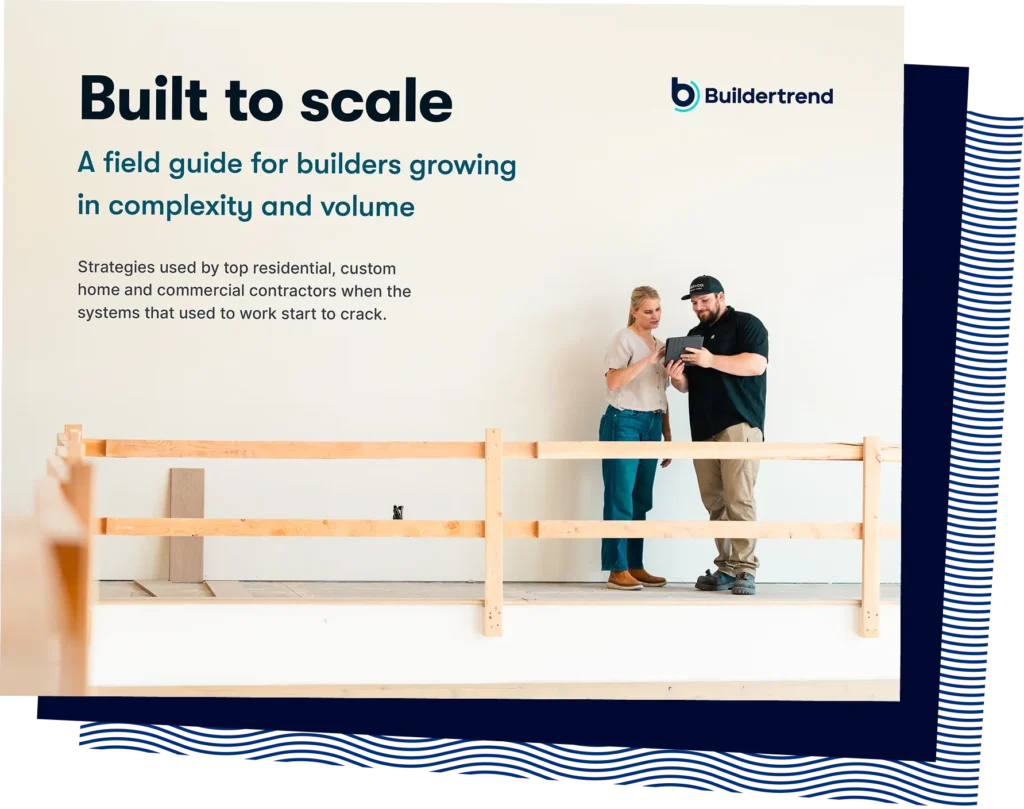
Built to scale: A field guide for builders growing in complexity and volume
Strategies used by top residential, custom home and commercial contractors when the systems that used to work stop working.
At some point, almost every builder hits the same quiet realization: the business outgrew whatever was running it, and nobody noticed until the numbers started telling a successful story than the schedule did. This field guide names the three hurdles and walks through what actually closes each one. No feature list. No pitch.
Is this you?
A custom or luxury home builder running several complex projects at once
A high-end remodeler fielding more inquiries than you can comfortably staff
A light commercial GC taking on buildout work that used to belong to firms twice your size
A specialty trade contractor running fifteen active jobs instead of five
The important stuff still lives in five different tools instead of one
Only one or two people really know what’s happening across every active job
You already solved “how do we win the next job,” and now you’re facing what comes after

Why growth breaks the old systems
Custom home building is one of the bright spots in residential construction right now. Starts are up 3% while overall single-family construction is down 5%, and custom now makes up roughly a fifth of every single-family home built in the country. That kind of growth is easy to read as proof the business behind it is running well. Growth and stability aren’t the same thing, and plenty of builders are learning that the hard way, mid-expansion.
It isn’t only custom builders feeling it. Remodelers are fielding more inquiries than they can comfortably staff. Light commercial GCs are taking on buildout work that used to belong to firms twice their size. Specialty trades are running fifteen active jobs instead of five. Different segment, same math: more work moving through the same systems that used to be enough.

What this guide covers
This book is for builders who already have the volume, the crew and the reputation, and are now facing a quieter problem: the business has grown past the point where any one person can carry it all in their head. Inside, you’ll find:
Three obstacles almost every scaling builder hits, and which one is likely closest for your business.
Five practical, software-agnostic tools you can run against your own numbers this week.
A real case study of a $6M custom home builder who went from survival-level margins to a 23% goal.
A free self-assessment, the Scale Health Check, to score exactly where your business stands today.
- What’s inside
What’s inside
The 3 challenges that stall growing construction businesses
As many builders scale, they experience growing pains as one long stretch of feeling busier than ever while trusting the numbers less. This guide breaks it apart into three specific pressure points, so it’s possible to see exactly which one is closest to breaking.

Chapter 1: Grow faster
The real test isn’t whether the business can win the next job. It’s whether it could survive ten times the volume it’s running today without the whole thing coming apart at the seams that used to hold just fine. Complexity doesn’t grow at the same pace as headcount, and a crew that could once track four jobs by memory starts to strain at eight.
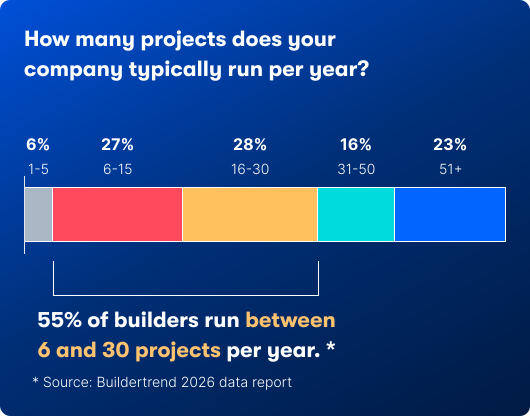
Our customer data report found 55% percent of top builders are already running between six and thirty projects a year, so for most of this audience, that’s not a future problem. It’s already the job. Inside this chapter: the Capacity Gut-Check, three blunt questions that surface whether growth is riding on real systems or on one or two people holding it all together.

Chapter 2: Work smarter
Follow one change order from a client’s decision to the accounting entry to a text to the sub, and the leak becomes obvious: the same piece of information typed into three places, with three chances for something not to match. This risk is the mechanism behind a good chunk of missing margin on jobs that otherwise look clean on paper.
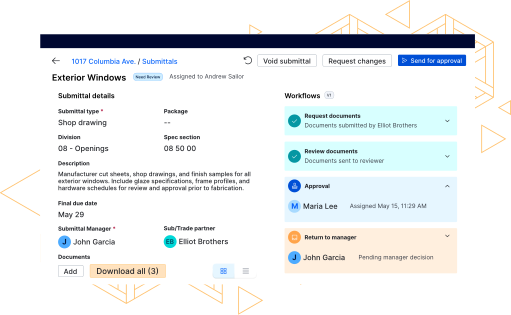
The same drag shows up the moment a design partner is in the mix. A submittal left unanswered for more than five days carries a 60% chance of knocking the schedule off track. Inside this chapter: the Tool Sprawl Audit and the Design Partner Cadence, two tools built for two different leaks – one internal, one external.

Chapter 3: Build bigger
Capacity strain and manual waste don’t stay contained to a schedule or a spreadsheet. Eventually, they show up as cash: a job that’s profitable on paper but slow to pay out, a margin that looked solid in the estimate and thinner by the time the job closes.
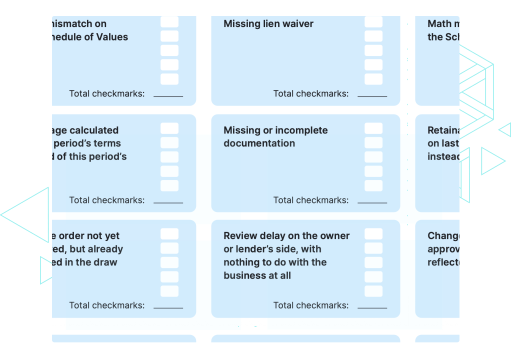
Inside this chapter: the Draw Rejection Post-Mortem, a checklist that turns “billing is just slow sometimes” into a specific, fixable process gap.


Built to Scale. Built for you.
Get Buildertrend’s free field guide for builders managing more complexity and volume than ever.
- Diagnostics inside
Diagnostics inside
Five tools you can run against your own business today
This is more than a book of theory. Every chapter closes with something to actually do, no software required, built to surface exactly where a business is exposed before it costs a real job.
Your single source of truth for efficiency, collaboration and profitability

The capacity gut-check
Three questions, answered honestly, that reveal in under a minute whether a business could take on real growth or is just getting by at the volume it’s already at: the bottleneck test, the yes/no test and the delegation test.
The tool sprawl audit
A numbers exercise. Pull the last five active jobs and check the math in three specific places where the same information tends to get entered more than once: change orders, selections and sub or vendor payments. This is where money quietly leaks out of jobs that otherwise look profitable.
The design partner cadence
What to put in writing before the first week is over on any job with an outside design partner, so a submittal without a deadline stops being a wish and starts being a real request.
The draw rejection post-mortem
Pull the last three to five draws and check each one against the usual suspects: a math mismatch on the Schedule of Values, a missing lien waiver, retainage calculated on the wrong terms. If the same box gets checked more than once, that’s not bad luck. That’s a process gap with a name on it.
The Scale Health Check
The tool that closes the book. Eleven statements across three categories (capacity, systems and cash) scored to give an honest read on exactly where a business stands today, and revisited every quarter to track the shift.

Built to Scale. Built for you.
Get Buildertrend’s free field guide for builders managing more complexity and volume than ever.
- The story and the solve
The story and the solve
Businesses that already closed this gap
This guide opens with a builder who once had to ask, at two in the morning, where the money went. It closes with builders who scaled well past their starting size, including a custom home builder whose margins once hit survival level and are now on track for a 23% goal.
Case study preview
Meg Billings started Meg & Co. building starter spec homes. Today, her company builds custom homes north of $6 million, running four to six projects at a time across two markets. Getting there meant a mid-project moment where the real numbers painted a very different story than the one she expected.

“It’s catastrophic to a business if you don’t know where you’re going.”
— from the case study insideFrequently asked questions
A few signs show up consistently: only one or two people really know what’s happening across every active job, new jobs get accepted based on calendar space rather than a clear read on capacity and the same information (a change order, a selection) gets entered across several different point solutions. Several of these happening at once usually means the systems running the business haven’t kept pace with its growth.
Timing, not tight margins. Ninety percent of decision-makers at construction firms operating at a larger scale say cash flow timing has cost them profitable work, and 43% say they’ve passed on profitable projects more than once because of it. The risk is the gap between when a cost gets absorbed and when the paperwork to bill for it actually clears.
Beyond the direct cash gap, a rejected or delayed draw typically forces a resubmission cycle, and the review doesn’t reward being close: a draw that’s 98% complete with one missing lien waiver goes back to square one for review, the same as a draw with ten errors. Builders who track the specific cause behind repeated delays (a documentation gap, a retainage miscalculation) usually find one or two patterns repeating, not five different problems.
It’s a free, eleven-question self-assessment included in Buildertrend’s Built to Scale field guide. It scores a construction business across three categories – capacity, systems, cash – and gives an honest read on exactly where the business stands today. It’s designed to be run once and revisited every quarter.
What “the solve”
actually meansEvery diagnostic in this guide works on its own. But once the three walls are named and the self-assessment is run, the guide closes by showing exactly where the pieces come together – mapped pillar by pillar to what actually fixes each one, and where the businesses in this book found the systems that got them there.





Unlock the full guide

Based on 5,000 reviews on



Tell us a bit about yourself
By submitting this form, you are agreeing to our Terms and Conditions Agreement and Privacy Notice. This site is protected by Google reCAPTCHA